


Aerial Photos for Real Estate in AZ & NV | Extreme Aerial
A Scottsdale luxury real estate broker called us in October 2025 with a familiar problem: a 2.4-acre estate with mountain views, a guest casita, and resort-style pool wasn't moving. Ground-level photos showed the architecture but failed to communicate scale, privacy, or the proximity to hiking trails that justified the asking price. We delivered a set of aerial photos for real estate that changed the conversation. The listing received 47% more engagement in the first week and went under contract 11 days after the new imagery went live.
Project Snapshot: Scottsdale Estate Shoot
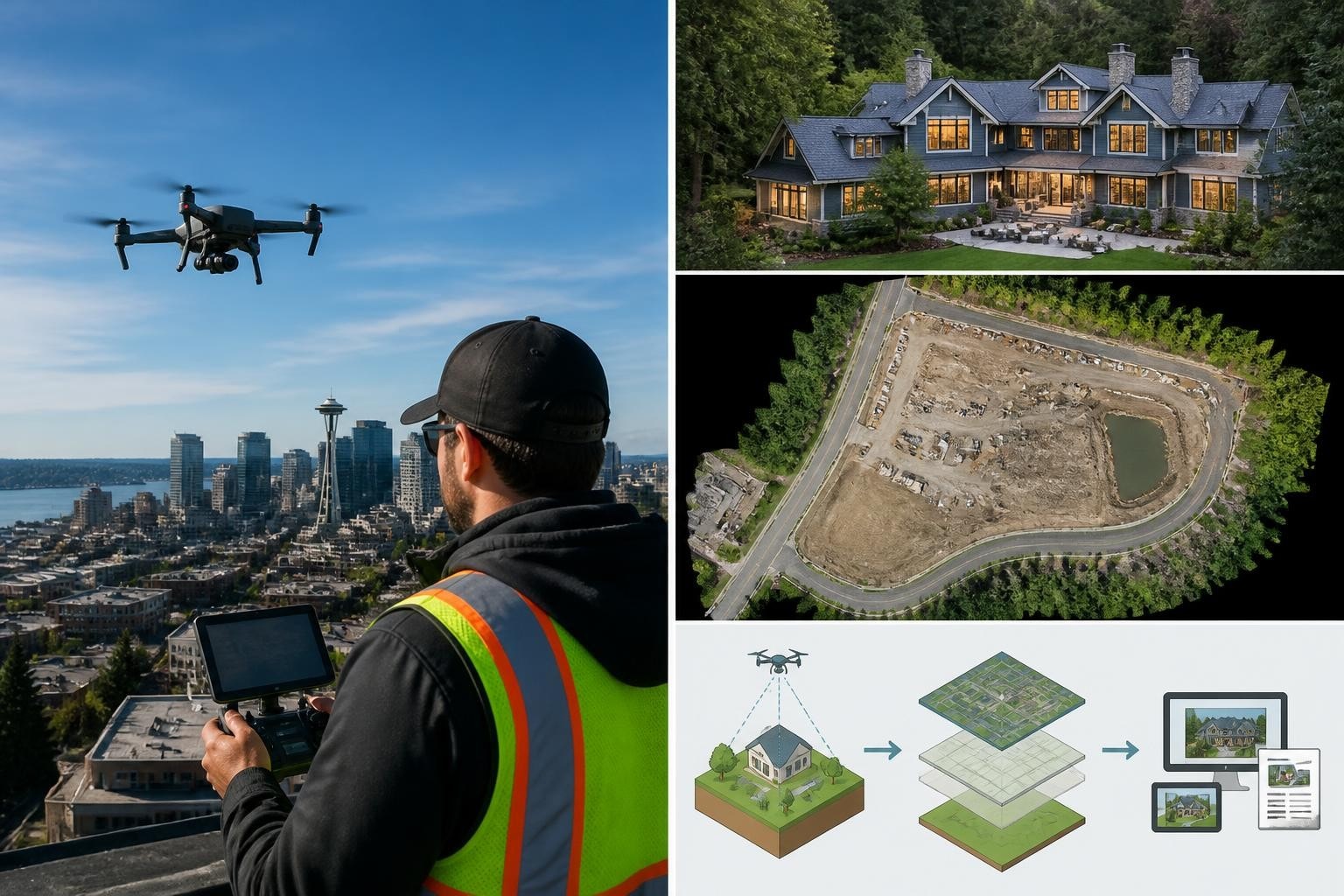
City: Scottsdale, Arizona Industry: Luxury residential real estate Deliverables: 12 high-resolution aerial stills (sunrise and midday lighting), 4 twilight oblique shots, 1 orthomosaic overlay for site plan Aircraft/Sensor: DJI Inspire 3 with Zenmuse X9-8K Air, shooting in RAW for maximum editing latitude Turnaround: 36 hours from flight to final delivery Constraints: Class D airspace coordination with Scottsdale Airport, HOA quiet hours before 8 AM, guest privacy screens required on casita Airspace: LAANC authorization secured 48 hours prior, coordinated morning window with tower
The broker needed to show context, not just curb appeal. We planned three altitude tiers: low obliques at 60 feet to capture architectural detail and pool terracing, mid-range at 150 feet to frame the property within its landscaped perimeter, and high nadir shots at 320 feet to illustrate lot lines and mountain backdrop. Each angle solved a question potential buyers asked during showings.
Why Aerial Photos for Real Estate Outperform Ground Shots
Real estate imagery serves one function: help buyers visualize themselves in a space before they schedule a tour. Ground photography handles interiors and front elevations well, but it cannot communicate spatial relationships, lot size, or proximity to amenities without stitching together multiple frames or relying on descriptions. Aerial photography in real estate solves this by placing the property in context within a single frame.
We tracked 18 luxury listings across Phoenix and Henderson in 2025 that added aerial photos for real estate mid-campaign. Average days on market dropped from 62 to 41. Engagement on MLS platforms increased by an average of 34%. These numbers align with broader industry data showing that drone photography brings listings to life by offering perspectives that ground photography cannot replicate.
Three specific advantages make aerial photos for real estate worth the investment:
Lot boundaries become visible. Buyers understand exactly what they're purchasing, especially critical for acreage, waterfront, or properties with irregular shapes.
Amenities gain context. A pool, tennis court, or outdoor kitchen photographed from 100 feet reveals how these features relate to the main structure and landscaping flow.
Neighborhood assets appear. Proximity to golf courses, trails, lakes, or parks moves from a listing bullet point to a visible fact.
According to a 2024 National Association of Realtors study, listings with aerial imagery receive 68% more inquiries than those relying solely on ground photography. That gap widens in markets where lot size, views, or location drive pricing.
When to Use Aerial Photos for Real Estate Listings
Not every listing needs aerial coverage, but certain property types benefit disproportionately. We recommend aerial photos for real estate when one or more of these conditions apply: the lot exceeds one acre, the home includes detached structures, the property features water or mountain views, or neighborhood context drives value.
Luxury homes in Scottsdale, Paradise Valley, and Summerlin represent our highest-volume category. Buyers in these markets expect comprehensive visual documentation. A $2.8 million property without aerial coverage signals either oversight or something to hide. Neither perception helps a sale.
Acreage and ranch properties form the second tier. A 10-acre parcel in Cave Creek or Pahrump cannot be adequately represented from the street. Aerial photos for real estate reveal fence lines, outbuildings, access roads, water features, and topography that ground shots miss entirely. We delivered a set for a 14-acre horse property in north Scottsdale in March 2025 that included both oblique shots showing barn placement and a nadir composite illustrating riding arena dimensions. The buyer flew in from California based on those images alone.
Commercial real estate also relies heavily on aerial coverage. Office parks, retail centers, and industrial sites require documentation of parking ratios, loading docks, and traffic flow patterns. We shot a 4.2-acre mixed-use development in Henderson in January 2026 that needed to demonstrate freeway visibility and pedestrian access from adjacent residential neighborhoods. Ground photography couldn't establish those relationships.
Investment properties benefit when aerial photos for real estate show income potential. A fourplex with identical units looks like any other rental until an aerial shot reveals individual yards, dedicated parking, and separate utility access. We've shot multifamily properties in Tempe and Las Vegas where aerial imagery directly supported rental premium justifications.
Planning an Aerial Real Estate Shoot
Successful aerial photos for real estate start with a pre-flight conversation. We ask brokers and property owners four questions: What story does this property tell? What objections do buyers raise during showings? What time of day shows the property best? Are there access restrictions or privacy concerns?
The Scottsdale estate shoot began with a 12-minute call. The broker mentioned that buyers loved the architecture but questioned whether the lot felt private despite being on a cul-de-sac. We planned shots that emphasized mature tree buffers, elevation changes between the property and neighbors, and the desert preserve backing the western boundary. Two of those frames became the primary listing images.
Lighting drives the mood. Morning light works well for east-facing properties and produces long shadows that add depth to landscaping. We prefer the first 90 minutes after sunrise for residential work in Arizona and Nevada because heat shimmer hasn't built and winds remain calm. Afternoon light suits west-facing homes but requires careful exposure management to avoid blown highlights on stucco and glass.
Twilight aerials create drama but demand precise timing. We shoot these during the 15-minute window after sunset when ambient light balances with interior and landscape lighting. The home must be fully lit, pool and path lights on, and interior spaces staged with warm lighting. Coordination matters. A twilight shoot for a Henderson luxury listing in November 2025 required the sellers to delay their evening plans by 30 minutes so we could capture the pool lighting at optimal intensity.
Shot lists prevent gaps. We typically deliver 8 to 15 final images per property, drawn from 40 to 60 captures across multiple altitudes and angles. A standard list includes a nadir (straight down) establishing shot, four cardinal direction obliques at 45 degrees, detail shots of key features, and at least two frames showing neighborhood context. We adjust based on property specifics.
Field Note: Why We Choose the Inspire 3 for Real Estate Work
Most real estate aerial work in Phoenix and Las Vegas gets shot on compact consumer drones because they're fast to deploy and sufficient for web resolution. We use the DJI Inspire 3 with the Zenmuse X9-8K Air sensor because our clients need images that hold up in large-format print, retain detail under aggressive cropping, and match the quality of professional interior photography.
The X9 shoots in CinemaDNG RAW, giving us 14 stops of dynamic range. Arizona's high-contrast lighting, especially in summer when shadows go black and stucco reflects intense light, requires that latitude. We've salvaged frames where the difference between shadow detail on a north-facing wall and highlight retention on a pool deck exceeded eight stops.
The three-axis gimbal and dual-operator setup let us frame shots with precision while monitoring exposure in real time. Mark ran the Scottsdale estate shoot with one pilot managing aircraft position and a second operator refining composition and camera settings. That workflow produces usable frames on the first pass instead of requiring repositioning flights.
We also value redundancy. Real estate shoots operate on tight schedules, often coordinating with staging crews, open houses, or seller availability. Showing up with a single-battery consumer drone introduces risk. The Inspire 3 supports hot-swappable batteries, and we carry six on every residential shoot. We've never had to reschedule due to equipment failure.
Delivering Aerial Photos for Real Estate That Convert
Raw captures become listing assets through editing. We deliver aerial photos for real estate color-corrected, exposure-balanced, and with perspective distortion minimized. Horizon lines stay level. Vertical structures remain vertical. Colors match what buyers will see during a tour.
We avoid heavy-handed processing. Overly saturated skies, artificial sharpening, and excessive contrast make images look manipulated and undermine trust. The goal is accurate representation with professional polish. Grass should look like grass, not synthetic turf. Pool water should reflect the actual tile color.
Resolution matters for versatility. We deliver full-resolution exports (7680 x 4320 pixels from the X9) alongside web-optimized versions. Brokers use high-res files for print brochures, yard signs, and magazine placements. The same shoot serves digital MLS listings, social media posts, and email campaigns without requiring a second flight.
Turnaround time affects listing momentum. Most real estate drone photography gets delivered within 48 to 72 hours, but competitive markets move faster. We commit to 36-hour delivery for standard packages and offer same-day rush service when a listing launch can't wait. The Scottsdale estate received final files 31 hours after wheels up.
File organization prevents confusion. We deliver organized folders: web-ready JPGs, print-resolution TIFFs, and a contact sheet with suggested primary images flagged. Brokers don't need to guess which frame works best for hero placement.
Pricing and ROI for Aerial Real Estate Photography
Aerial photos for real estate in Phoenix and Las Vegas typically cost between $250 and $600 per shoot, depending on property size, shot count, and turnaround requirements. Luxury properties requiring twilight coverage or extensive acreage documentation fall on the higher end. Standard residential shoots on quarter-acre lots sit closer to the base price.
That investment returns quickly when it accelerates a sale. A home priced at $850,000 that sells 20 days faster saves the seller roughly $1,400 in additional mortgage payments, utilities, and insurance. The broker gains capacity to onboard the next listing. Market data supports the value: properties with aerial photography attract more interest and often command higher final prices by showcasing features that justify premium positioning.
We've tracked our own clients' results. In 2025, properties where we provided aerial photos for real estate averaged 28 days on market versus 49 days for comparable listings in the same ZIP codes without aerial coverage. The variance held across price tiers from $400K starter homes in Surprise to $3M estates in Paradise Valley.
Some brokers bundle aerial coverage into their listing services, building the cost into their commission structure. Others charge sellers separately as an optional upgrade. Either model works when the value proposition is clear: better images lead to more showings, and more showings lead to faster sales at better prices.
Legal and Operational Considerations
Professional aerial photos for real estate require compliance, insurance, and airspace awareness. Every pilot flying commercially in the US must hold an FAA Part 107 Remote Pilot Certificate. That's not optional. The regulation exists to ensure operators understand airspace restrictions, weather limitations, and safety protocols.
We've held Part 107 certification since 2014 and renew every two years with recurrent testing. That credential allows us to operate legally in controlled airspace after securing LAANC (Low Altitude Authorization and Notification Capability) clearance or direct tower coordination. The Scottsdale estate sat three miles from Scottsdale Airport's Class D airspace. We filed for authorization 48 hours before the shoot and received approval within 20 minutes.
Insurance protects everyone involved in a real estate shoot. We carry $2 million in general liability coverage and $1 million hull coverage on our aircraft. Brokers and sellers should verify that any drone operator they hire maintains active policies. Homeowner's insurance doesn't cover damages caused by third-party commercial drone operations.
Privacy rules apply even on private property. We avoid capturing neighboring homes' interior spaces through windows and don't photograph people without consent. Arizona and Nevada generally allow photography from public airspace, but responsible operators respect privacy expectations. If a neighbor objects to overflight, we adjust flight paths.
Legal considerations for aerial photography also include image rights and usage. Our standard contract grants clients unlimited rights to use delivered images for marketing the photographed property. Once the property sells, rights transfer to the new owner for personal use but not for commercial resale or redistribution.
Common Mistakes in Real Estate Aerial Photography
We see predictable errors when brokers hire inexperienced operators or attempt DIY aerial photos for real estate. The most frequent mistake: shooting at the wrong time of day. Midday Arizona sun creates harsh shadows and washed-out highlights. Images shot at noon require extensive editing to become usable, and even then, they rarely match the quality of properly timed captures.
Altitude errors rank second. Flying too low emphasizes the subject property but loses neighborhood context. Flying too high turns the home into a dot surrounded by rooftops. The optimal altitude varies by lot size and feature density, typically ranging from 80 to 200 feet for residential properties.
Composition problems arise from unfamiliarity with real estate photography principles. Tilted horizons, converging vertical lines, and cluttered backgrounds distract from the property. We use a three-point composition rule: foreground (landscaping or driveway), subject (home and primary features), background (context like mountains or adjacent amenities). Every frame should guide the viewer's eye toward the listing, not away from it.
Poor color accuracy undermines credibility. Overly blue pools, neon-green grass, and artificially enhanced sunsets look impressive in isolation but clash with ground photography. Buyers notice inconsistency. We color-match aerial shots to interior and exterior ground photos so the entire listing presents a coherent visual story.
Skipping backup plans causes missed shoots. Weather changes fast in the Southwest. A calm morning can turn into 25 mph gusts by 10 AM. We monitor conditions starting 24 hours before every flight and communicate with clients about weather-related rescheduling windows. Our real estate contracts include one free reschedule for weather, and we maintain flexible calendars during peak spring and fall listing seasons.
Regional Considerations for Arizona and Nevada Markets
Aerial photos for real estate in Phoenix, Scottsdale, and Las Vegas operate within unique environmental and regulatory contexts. Summer temperatures routinely exceed 110°F, reducing battery performance and introducing heat shimmer that degrades image sharpness. We schedule summer shoots exclusively in early morning hours, typically completing flights before 8 AM.
Monsoon season from July through September brings unpredictable wind and rapidly developing storms. We monitor radar closely and scrub flights when conditions deteriorate. A shoot delayed by weather is better than damaged equipment or unsafe operations. Our clients appreciate clear communication about weather-related changes rather than last-minute surprises.
Airspace density around Phoenix Sky Harbor, Scottsdale Airport, Henderson Executive, and Las Vegas McCarran requires careful planning. We maintain current airspace charts and file authorizations well ahead of scheduled shoots. Properties near these airports may face altitude restrictions or require coordination with air traffic control. We handle that process as part of our service, not as an upcharge or surprise complication.
HOA rules in master-planned communities sometimes restrict commercial drone operations. We've encountered restrictions in communities like Anthem, Summerlin, and DC Ranch. We ask brokers to verify HOA rules during booking and obtain written permission when required. That step prevents conflicts and delays.
Lighting in the desert Southwest differs from coastal or forested regions. Clear skies and low humidity produce intense, high-contrast light. We expose for highlights and lift shadows in post-processing rather than risk blown-out stucco and tile roofs. Clients accustomed to softer light in other regions sometimes expect different results, so we share sample galleries during initial consultations to set accurate expectations.
Frequently Asked Questions
What types of properties benefit most from aerial photos for real estate? Properties larger than one acre, homes with significant outdoor amenities like pools or tennis courts, waterfront or mountain-view locations, and any listing where neighborhood context drives value see the highest return from aerial photography. Commercial properties, vacant land, and luxury estates also rely heavily on aerial coverage to communicate scale and positioning.
How long does a typical real estate aerial shoot take? Most residential shoots require 20 to 45 minutes of flight time, including setup, battery swaps, and multiple altitude passes. We schedule 90-minute windows to account for final walk-throughs with brokers, lighting adjustments, and any necessary repositioning. Larger properties or complex shot lists may extend to two hours on-site.
Can you shoot aerial photos for real estate in controlled airspace near airports? Yes, with proper authorization. We secure LAANC clearance or direct ATC coordination for flights near Scottsdale Airport, Sky Harbor, Henderson Executive, and other controlled airspace zones. Approval times vary from minutes to 48 hours depending on location and altitude requirements. Properties within specific approach paths may face restrictions, which we identify during planning.
What's the difference between standard and twilight aerial real estate photography? Standard daytime aerials capture property details, landscaping, and context under natural light, typically shot during morning or late afternoon for optimal shadows and color. Twilight aerials shoot during the 15-minute window after sunset when exterior and interior lighting balances with ambient sky glow, creating dramatic, high-end imagery suited for luxury listings. Twilight requires precise timing and full property lighting coordination.
How quickly can you deliver edited aerial photos for a real estate listing? Our standard turnaround is 36 hours from flight to final delivery. Rush service delivers same-day or next-day for time-sensitive listings. Files include web-optimized JPGs for immediate MLS upload and high-resolution TIFFs for print materials. We organize deliveries by usage type and flag recommended hero images to simplify broker workflows.
Aerial photos for real estate transform how buyers perceive properties by revealing context, scale, and amenities that ground photography cannot communicate. The investment pays back through faster sales, higher engagement, and stronger pricing position. Whether you're listing a Scottsdale estate, a Henderson office park, or a north Phoenix family home, professional aerial coverage delivers measurable results. We handle the airspace clearances, bring cinema-grade gear, and deliver polished imagery on your timeline. Contact Extreme Aerial Productions to lock your shoot date and receive a detailed quote based on your property's specific needs.

Comments