


Your Drone Pilot. Your Reputation. Why Airport Airspace Matters.

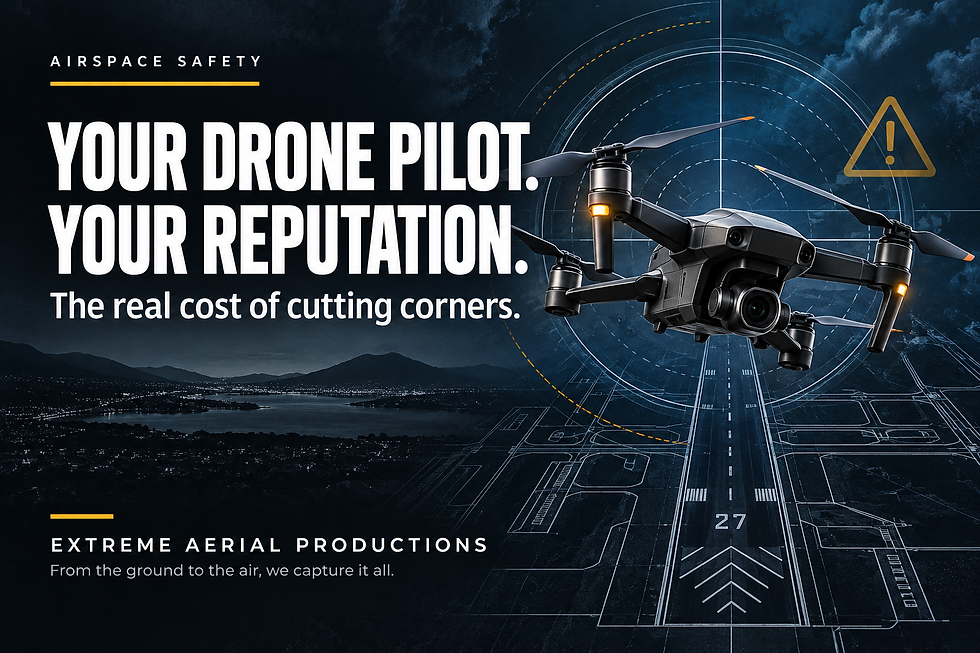
A drone flight can last a few minutes. The consequences of cutting corners can last much longer. When you hire someone to capture your project, you are trusting their judgment as well as their camera.
The news behind the conversation
An October 8, 2026, announcement from the U.S. Attorney’s Office for the Northern District of Texas describes a Dallas man’s indictment over alleged unauthorized drone flights near Dallas Love Field and Dallas Fort Worth International Airport. The allegations include a flight across an active runway at Love Field. An indictment is not a conviction; the defendant is presumed innocent unless proven guilty.
The sUAS News report linked below prompted this article. For businesses commissioning drone work, it raises a practical question: does your operator understand what must happen before the aircraft leaves the ground?
Airport-area work starts before takeoff
At Extreme Aerial Productions, flying around airports is part of our weekly work. Our experience includes projects near Luke Air Force Base, Davis-Monthan Air Force Base, Harry Reid International Airport in Las Vegas (formerly McCarran), and local municipal airports.
That experience does not give us unrestricted access. Each operation must fit the applicable airspace requirements, authorization conditions, and operating limits. Working near a military base does not mean permission to fly over the installation.
When FAA DroneZone authorization is needed, we plan for the review process. It can take time, and we account for that when discussing a client’s schedule. Eligible operations may instead obtain authorization through LAANC.
The FAA’s current guidance says DroneZone review times vary and have historically taken up to eight weeks. That is planning guidance, not a guaranteed turnaround. Submitting an application does not authorize a flight.
Why this matters to your project
For a contractor, missed capture dates can leave gaps in progress documentation. For an engineer or survey team, a delayed collection can affect the intended data handoff. For a producer, an unworkable flight plan can disrupt a shoot.
That is why airspace planning belongs in the project conversation early. The site, capture area, required views or data, and timing all matter. A promise to “get it done” is only useful when the operator can explain how the work can be performed safely and lawfully.
Reckless disregard for FAA rules can endanger other airspace users and damage confidence in everyone connected with a project. Your reputation matters. So does ours. Neither should depend on somebody hoping the rules will not apply.
The question we bring to every flight
Is what we’re about to do safe and prudent?
That is our guiding question. Being good stewards of the National Airspace System is part of serving our clients properly. It means respecting the required permissions, staying within the approved limits, and being prepared to delay a flight when the conditions are not right.
For us, this is about more than collecting a paycheck. Clients trust us to do a good, correct, safe job with their project data capture and production work. We intend to earn that trust every time.
Planning drone work near an airport in Arizona or Las Vegas?
Send Extreme Aerial Productions your project location, required deliverables, and target dates. We can assess the airspace requirements early and discuss a realistic approach for construction progress monitoring, data acquisition supporting engineers and licensed surveyors, or TV and commercial production.
From the ground to the air, we capture it all.


Comments