


Aerial Photography for Construction: Proven Results for AZ & NV
- Extreme Aerial

- May 4
- 14 min read
Updated: Jul 30
When a Phoenix-based commercial developer needed weekly progress documentation for a 14-acre mixed-use development in Scottsdale, ground-based photography couldn't capture the full scope of foundation work, utility installation, and vertical construction happening simultaneously across six building pads. We deployed our DJI Matrice 300 RTK with a Zenmuse P1 camera to capture nadir and oblique imagery every Thursday morning between March and August 2025, delivering georeferenced orthomosaics and annotated site maps within 48 hours. The project manager reduced coordination meetings by 30% because subcontractors could review accurate site conditions before arriving, and the owner saved an estimated $47,000 in rework by catching grade discrepancies early. That's what aerial photography for construction delivers when you match the right platform to the project constraints.
Why Construction Projects Need Aerial Photography
Ground-level documentation misses critical spatial relationships. You can't see foundation alignment issues from the ground. You can't measure stockpile volumes with a tape measure. You can't show a lender the full scope of completed work with iPhone snapshots.
Construction aerial photography solves these problems by providing repeatable, high-resolution imagery that captures entire job sites in a single mission. According to the Associated General Contractors of America, 45% of construction firms used drones for progress tracking and site surveying in 2024, up from 22% in 2021. The shift happened because aerial data reduces site walks, improves stakeholder communication, and creates defensible records when disputes arise.
Stakeholder | How Construction Aerial Photography Helps |
Property Owner | Verifies project progress, creates permanent documentation, supports lender reporting. |
General Contractor | Tracks schedules, coordinates subcontractors, reduces unnecessary site walks. |
Superintendent | Monitors material staging, identifies conflicts, and improves daily planning. |
Investor / Lender | Receives visual proof of completed work before funding milestones. |
Marketing Team | Uses finished imagery and progress photography for leasing, investor updates, and project promotion. |
Common Uses for Construction Aerial Photography
Construction teams regularly use aerial imagery for:
Weekly project reports
Progress billing documentation
Safety briefings
Before-and-after project comparisons
Owner updates
Investor reporting
Marketing and leasing materials
Final project closeout documentation
We see three primary use cases across our Arizona and Nevada projects: weekly or monthly construction progress documentation, pre-bid site assessment, and final as-built verification. Each requires different flight patterns, resolution targets, and turnaround times. A progress flight over a 20-acre site in Henderson might take 18 minutes and deliver 400 images processed into a single orthomosaic. A pre-bid assessment for a civil contractor bidding on a Tempe infrastructure project might include thermal imaging to identify existing utilities and LiDAR for sub-canopy terrain mapping.
Project Snapshot: Weekly Progress Documentation
Client: Commercial developer
Location: Scottsdale, Arizona
Industry: Mixed-use construction
Deliverables: Orthomosaics (1.5 cm/px GSD), annotated PDFs, time-lapse sequences
Equipment: DJI Matrice 300 RTK, Zenmuse P1 (45 MP full-frame)
Turnaround: 48 hours from flight to delivery
Constraints: Active construction, crane operations, Class D airspace (Scottsdale Airport)
Airspace: Coordinated LAANC authorization for 350 ft AGL
The developer needed consistent documentation to track six building pads, underground utility installation, and material staging areas. We flew every Thursday at 7:00 AM before crane operations started, maintaining the same flight grid to ensure alignment across 22 weekly missions. The P1's mechanical shutter eliminated rolling shutter distortion, critical when capturing moving equipment and workers.
How Aerial Photography Improves Construction Workflows
Construction teams use aerial imagery to compress communication cycles and reduce field verification trips. When you deliver a georeferenced orthomosaic, the superintendent can measure distances, confirm material placement, and identify conflicts without walking the site. The cost savings compound over months-long projects.
Measurable benefits we've documented across 2024-2026 Arizona and Nevada projects:
Reduced coordination time: Project managers report 25-35% fewer coordination meetings when stakeholders review current site imagery before weekly planning sessions.
Faster dispute resolution: Timestamped aerial records resolve payment disputes and change order negotiations in days instead of weeks.
Improved safety: Site managers identify hazards like unstable slopes, standing water, and equipment placement issues from aerial overviews before workers encounter them.
Better marketing: Developers also use commercial drone photography and progress sequences in investor updates, leasing materials, proposals, and marketing campaigns.
Research on UAVs in construction demonstrates how drone-based imagery integrates with digital twins to enhance project monitoring and management. We've seen this firsthand on projects where we deliver weekly orthomosaics that import directly into BIM software, allowing engineers to overlay design models on actual site conditions.
Choosing the Right Flight Pattern and Resolution
Not every construction flight needs centimeter-level precision. A progress overview for a marketing video needs different specifications than a cut-fill volume calculation for an earthwork pay application. We match flight altitude, overlap percentage, and camera settings to your deliverable requirements.
Flight parameters for common construction missions:
Progress documentation: 200-250 ft AGL, 75% front overlap, 70% side overlap, delivers 2-3 cm/px GSD suitable for identifying completed work and material placement
Earthwork volumes: 150 ft AGL, 80% front/side overlap, 1-1.5 cm/px GSD, RTK or PPK georeferencing for accuracy within 0.05 ft vertical
Site inspection: 100-150 ft AGL, oblique angles (15-45 degrees off nadir), captures vertical surfaces like retaining walls, building facades, and excavation faces
Marketing aerials: Variable altitude (50-400 ft AGL), cinematic movement, ND filters for proper exposure, 4K or 6K resolution for large-format displays
We flew a pre-bid assessment for a civil contractor in Las Vegas in January 2026 that required both nadir orthomosaics for area calculations and oblique imagery to document existing drainage structures. The mission used 320 images captured at three different altitudes, processed into a single deliverable package that the estimating team used to refine their bid within the four-day proposal window.
Deliverables That Drive Decisions
Raw aerial photos have limited value. You need processed deliverables that answer specific questions: Is the foundation square? How much material is in the north stockpile? Did the grading contractor achieve design elevation?
We deliver outputs that integrate directly into your existing workflows. For construction drone services, that typically means georeferenced orthomosaics in GeoTIFF format, annotated PDF site maps with measurement overlays, and MP4 video sequences showing multi-week or multi-month progress.
Orthomosaics and Site Maps
An orthomosaic stitches hundreds of individual images into a single georeferenced aerial photograph with uniform scale. You can measure distances, calculate areas, and identify features with survey-grade accuracy when the underlying data comes from RTK-corrected drone positions.
On the Scottsdale mixed-use project, we delivered weekly orthomosaics as both high-resolution GeoTIFFs for the engineering team and compressed JPEGs with measurement annotations for the owner's weekly reports. The engineering team imported the GeoTIFFs into Civil 3D to verify that foundation walls matched design coordinates. The owner's reports included annotated PDFs showing percentage completion for each building pad, material stockpile locations, and any safety concerns flagged during the flight.
Volume Calculations and Cut-Fill Analysis
Earthwork contractors need defensible volume measurements for pay applications. We process aerial survey data into digital surface models that calculate cut and fill volumes against design grades or baseline surveys. Accuracy depends on ground control points and proper georeferencing, topics we cover in detail when discussing drone survey approaches.
A Henderson industrial project in fall 2025 required monthly volume calculations for imported fill material. We established eight ground control points using a survey-grade GPS unit, flew the site at 150 ft AGL with 80% overlap, and processed the data with Pix4Dmapper to generate a digital surface model. The calculated volumes matched the contractor's GPS-equipped dozer telemetry within 2.1%, well within acceptable tolerances for payment purposes.
Time-Lapse Sequences and Progress Videos
Owners, investors, and marketing teams want visual proof of construction momentum. A time-lapse sequence condensing six months of construction into 90 seconds shows progress more effectively than static photos. We create these sequences by flying identical flight paths at regular intervals, then aligning and processing the imagery into smooth video transitions.
The Scottsdale project's 22-week time-lapse became the developer's primary marketing asset for pre-leasing efforts. Prospective tenants could see foundation work, structural steel erection, and exterior envelope completion in a single video, reducing the conceptual gap between construction site and finished building. The leasing team reported that prospects who viewed the time-lapse were 40% more likely to schedule site tours than those who only saw renderings.
Equipment and Sensor Selection for Construction
Not every construction project needs the same drone platform. A tight urban site with overhead power lines requires different equipment than an open desert development. We select platforms and sensors based on site constraints, required accuracy, and deliverable specifications.
Our construction-focused platforms:
DJI Matrice 300 RTK: Primary platform for survey-grade work, 55-minute flight time, RTK positioning, supports P1 (45 MP), L1 (LiDAR), and H20T (thermal) payloads
DJI Mavic 3 Enterprise: Backup and tight-access platform, 45-minute flight time, 20 MP sensor, suitable for progress documentation where sub-2 cm GSD isn't required
Autel EVO II Pro RTK: Alternative platform for sites requiring U.S.-manufactured equipment per client specifications, 40-minute flight time, 20 MP 1-inch sensor
The Matrice 300 RTK handles 90% of our construction missions because the RTK system eliminates the need for ground control points on progress documentation flights. We achieve 3-5 cm absolute accuracy without GCPs, sufficient for most progress tracking and site inspection work. When we need sub-centimeter accuracy for earthwork volumes or as-built verification, we establish GCPs and use PPK processing to refine the positional data.
Field Note: Why We Chose RTK Over Traditional Workflows
Before we integrated RTK platforms in 2022, every survey-grade construction flight required a ground crew to establish and measure control points. On a 20-acre site, that meant two people spending 90 minutes placing and surveying eight to twelve targets before we could fly. RTK eliminated that bottleneck. Now we verify our base station position, launch, and start capturing data within 15 minutes of arriving on site. The time savings matter when you're coordinating around active construction schedules and weather windows. For clients running tight schedules, RTK means we can fly, process, and deliver the same day if needed. Mark tested three RTK platforms in early 2022 and selected the Matrice 300 RTK based on battery life, payload flexibility, and positional accuracy across six calibration flights at our Phoenix test range.
Managing Airspace and Site Coordination
Construction sites in Phoenix and Las Vegas often sit beneath controlled airspace or near active airports. Scottsdale Airport, Phoenix Sky Harbor, Henderson Executive, and Las Vegas McCarran all create airspace constraints that require coordination before we fly.
We handle LAANC (Low Altitude Authorization and Notification Capability) authorizations for sites in controlled airspace, submit waivers when projects require flight above 400 ft AGL, and coordinate directly with air traffic control on sites where construction cranes penetrate controlled airspace. The Scottsdale mixed-use project sat 2.1 miles from Scottsdale Airport in Class D airspace, requiring LAANC authorization for every flight. We submitted requests 24 hours in advance and received approval for 350 ft AGL operations within minutes through the automated system.
Site coordination matters as much as airspace clearance. We brief superintendents on flight paths, timing, and any restrictions (areas we'll avoid, altitude limits near cranes). On active sites, we coordinate with crane operators to ensure they know when we'll be airborne. These briefings take 5-10 minutes and prevent conflicts that could delay the flight or disrupt site work.
Progress Tracking Across Project Phases
Aerial photography for construction serves different purposes during excavation, foundation work, vertical construction, and closeout. Your documentation strategy should match the project phase and the questions stakeholders need answered.
Phase-specific aerial documentation:
Site preparation and excavation: Establish baseline topography, track cut/fill quantities, verify erosion control installation, document existing conditions before ground disturbance
Foundation and utilities: Confirm layout accuracy, verify formwork placement, document underground utility installation before backfill, measure foundation wall elevations
Vertical construction: Track structural steel or concrete frame erection, verify material deliveries and staging, document roof membrane installation, capture facade progress for owner updates
Site work and closeout: Verify final grades match design, document landscaping installation, capture completed project for marketing and as-built records, create final site map showing all improvements
A Tempe office building project we flew in 2024-2025 demonstrates this phased approach. We captured pre-construction site conditions in August 2024, establishing baseline topography and documenting existing vegetation. Monthly flights during excavation and foundation work tracked soil removal quantities and verified foundation wall placement. Weekly flights during structural steel erection gave the owner progress updates for investor reports. Final flights in March 2025 documented completed site work, landscaping, and parking areas for as-built records.
The value of phased aerial documentation extends beyond the current project. When the same owner broke ground on a second office building 400 yards from the first in fall 2025, we referenced the original baseline survey to establish consistent coordinate systems and reused flight plans that accounted for the site's airspace restrictions. That continuity saved the owner money and ensured their project archive used compatible data formats.
Real-World Results From Arizona and Nevada Projects
Numbers matter more than promises. Here's what aerial photography for construction has delivered across our recent Arizona and Nevada projects:
Scottsdale mixed-use development (March-August 2025):
22 weekly flights, 8,800 total images captured
Orthomosaics delivered within 48 hours 100% of missions
Project manager reported 30% reduction in coordination meeting time
Owner identified and corrected $47,000 in potential rework through early detection of grade discrepancies
Time-lapse sequence generated 1,400 views on developer's website, 40% increase in site tour requests
Henderson industrial earthwork project (September-December 2025):
Monthly volume calculations, eight ground control points per mission
Calculated fill volumes matched GPS dozer telemetry within 2.1%
Contractor reduced survey crew site visits from weekly to monthly, saving approximately $12,000 over four months
Owner approved payment applications within 48 hours versus previous 7-10 day review cycles
Tempe office building (August 2024-March 2025):
Baseline survey plus 24 progress flights over nine months
Delivered phased documentation covering excavation, foundation, structural frame, and site work
Final as-built orthomosaic and site map delivered to owner's engineer for record drawings
Owner reused baseline data and flight plans for second building, reducing setup costs by $3,200
These projects share common elements: clear deliverable requirements, consistent flight schedules, and coordination between our team and site management. The results come from matching equipment to requirements and delivering processed data that answers specific questions.
Integration With Project Management and BIM Workflows
Aerial imagery becomes more valuable when it integrates with tools your team already uses. We deliver data in formats that import directly into Procore, Autodesk Construction Cloud, Civil 3D, and other common construction platforms.
Georeferenced orthomosaics import as underlays in CAD software, allowing engineers to verify as-built conditions against design models. Time-stamped imagery uploads to project management platforms create visual records linked to schedule milestones. Digital surface models export as point clouds for BIM integration. These workflows turn aerial data into actionable information instead of file archives that no one reviews.
A Phoenix-area general contractor we work with imports our weekly orthomosaics into Procore as site plan overlays. Field engineers annotate the imagery with RFIs, change orders, and progress notes, creating a georeferenced project history that links visual documentation to specific schedule activities. When the owner questions a payment application or a subcontractor disputes completion percentages, the team pulls up the relevant orthomosaic with annotations and resolves the issue without site visits.
Selecting an Aerial Photography Provider for Construction
You need a provider who understands construction schedules, delivers on time, and coordinates with active site operations. Technical capability matters, but so does communication and reliability. Missed flights delay decision-making. Poor coordination disrupts site work. Slow turnaround makes the data irrelevant.
What to verify before hiring:
Construction-specific experience: Ask about previous projects similar to yours, what deliverables they produced, and how they handled airspace or site constraints
Equipment and backup systems: Confirm they bring backup drones, batteries, and data storage to prevent delays from equipment failures
Turnaround guarantees: Get specific commitments on processing and delivery timelines, not vague promises of "fast" service
Insurance and compliance: Verify they carry commercial drone insurance and that pilots hold current Part 107 certifications
Airspace coordination capability: Ensure they handle LAANC authorizations, waiver applications, and ATC coordination rather than expecting you to manage it
We've built our Phoenix and Las Vegas construction practice on delivering what we promise when we promise it. When we commit to 48-hour turnaround, we deliver in 48 hours. When we schedule a Thursday morning flight, we arrive with backup equipment and contingency plans for weather delays. That reliability matters when project schedules compress and decisions depend on current data. Our construction photography services page outlines our standard deliverables and turnaround times for different project types.
Cost Considerations and Project Budgeting
Aerial photography for construction costs depend on site size, flight frequency, deliverable complexity, and turnaround requirements. A single progress flight over a five-acre site with standard orthomosaic delivery costs less than monthly volume calculations requiring ground control and survey-grade processing.
Typical cost factors:
Site size and complexity: Larger sites require longer flights, more images, and increased processing time
Flight frequency: Weekly flights cost less per mission than one-off visits due to reduced mobilization and setup
Deliverable requirements: Standard orthomosaics cost less than volume calculations, 3D models, or custom annotations
Turnaround time: Same-day or next-day delivery costs more than standard 48-72 hour processing
Airspace coordination: Sites requiring special waivers or ATC coordination may include additional coordination fees
Most construction clients benefit from monthly or weekly flight schedules priced as package rates rather than individual missions. A weekly progress package for a mid-size site might include the flight, orthomosaic processing, annotated PDF delivery, and cloud storage for $800-1,200 per mission depending on site size and turnaround requirements. That investment typically saves multiples of its cost through reduced coordination time, faster dispute resolution, and early problem detection.
For projects requiring survey-grade accuracy with ground control, expect additional costs for GCP establishment and survey verification. Some clients provide their own surveyed control points to reduce costs. Others prefer we handle the complete workflow to ensure compatibility between aerial data and ground measurements.
Frequently Asked Questions
How accurate is aerial photography for construction documentation?
Accuracy depends on the equipment, flight parameters, and georeferencing method. Standard photogrammetry using consumer drones without ground control typically achieves 5-15 cm horizontal accuracy and 10-30 cm vertical accuracy, sufficient for general progress documentation and site overviews. RTK-equipped platforms like our Matrice 300 RTK achieve 3-5 cm absolute accuracy without ground control, suitable for most construction tracking and measurement tasks. When projects require survey-grade accuracy below 2 cm, we establish ground control points and use PPK processing to refine the data, achieving vertical accuracy within 0.02-0.05 ft.
What weather conditions prevent construction aerial photography flights?
We can't fly safely in rain, high winds above 20-25 mph, or low visibility conditions. Light clouds don't prevent flights, but heavy overcast can create flat lighting that reduces image quality and makes feature identification difficult. In Phoenix and Las Vegas, summer monsoons and winter storm systems create the most weather delays. We monitor conditions closely and reschedule flights when weather threatens safety or data quality. Our standard practice is to confirm flight readiness 12-24 hours in advance and maintain backup dates when weather looks marginal. Most construction schedules have enough flexibility to accommodate one or two weather delays per month.
How do you coordinate aerial photography with active construction operations?
We brief site superintendents on flight timing, coverage areas, and any operational restrictions before every mission. For sites with active crane operations, we coordinate directly with crane operators to ensure they know when we'll be airborne and at what altitudes. Most flights happen early morning before peak construction activity or during lunch breaks when equipment movement is minimal. The actual flight time is typically 15-25 minutes for sites under 30 acres, minimizing disruption to site work. We maintain visual observers to watch for ground hazards and communicate with site personnel if needed during the flight.
Can aerial photography detect foundation or grading problems before they become expensive?
Yes, when you fly at appropriate intervals and process the data with proper accuracy. We've helped clients identify foundation walls out of position by 8-12 inches, catch grading errors before paving started, and spot drainage problems during storms that revealed design flaws. The key is establishing baseline surveys that show design intent, then comparing progress imagery against those baselines. Digital surface models make this comparison straightforward because we can overlay design grades on actual site conditions and generate cut-fill maps showing where the site is high or low relative to design. Early detection prevents compounding errors and reduces rework costs.
What happens to the aerial data after project completion?
We deliver all processed data to you in formats you specify and maintain backup archives for 24 months. You own the data and can use it for future projects, legal documentation, marketing, or any other purpose. Many clients incorporate final orthomosaics and site maps into their as-built drawings and project closeout documentation. Some use progress sequences for case studies or marketing materials when bidding similar projects. We can provide raw images if needed for forensic analysis or litigation support, though most clients only need the processed deliverables. All data transfer happens through secure cloud storage or physical hard drives, and we handle file organization and naming conventions to match your project management structure.
Construction aerial photography delivers measurable value because it creates a permanent visual record that supports project management, documentation, stakeholder communication, and marketing throughout every phase of construction. Whether you need weekly progress tracking for stakeholder updates, survey-grade volumes for earthwork payment, or final as-built records for closeout documentation, the key is working with a provider who understands construction schedules and delivers processed data you can act on. We've been flying construction sites across Arizona and Nevada since 2014, and we know how to coordinate with active operations, handle airspace restrictions, and deliver results that stand up in meetings.
Ready to improve project visibility with recurring aerial documentation?
Request construction aerial photography from Extreme Aerial Productions, and we'll recommend the right flight schedule, deliverables, and reporting package for your project.
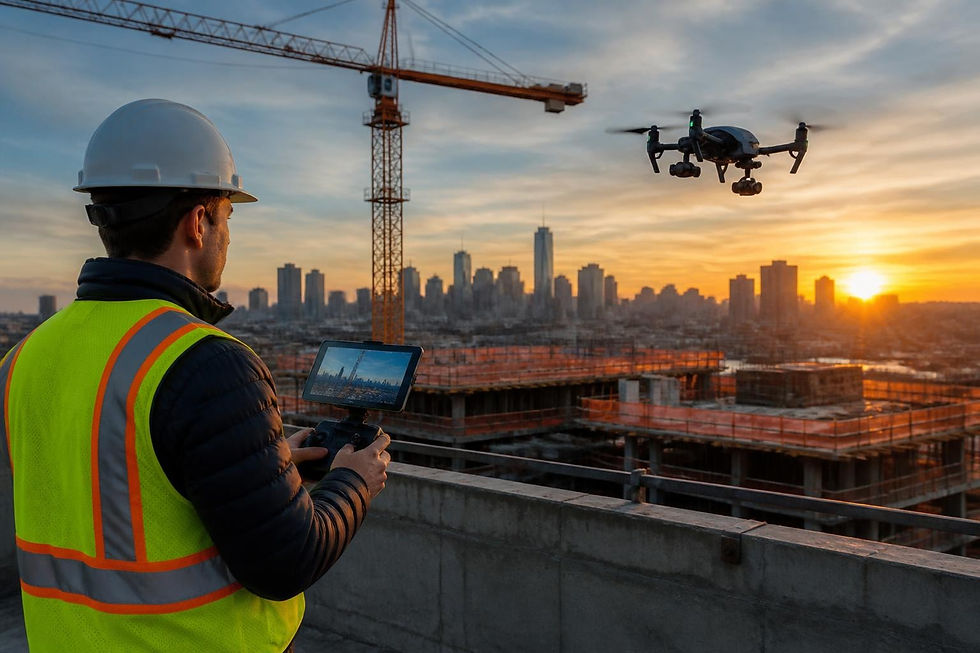


Aerial construction photography always makes me appreciate how important perspective and environment are to a shoot. The space behind the camera matters just as much as the equipment sometimes. That is one thing I like about Silk Screen Studio. The industrial character, natural light, and private setup give photographers room to plan, edit, meet clients, or prep for projects without working out of a cramped temporary spot.