


Why “Trust Me” Doesn’t Work Anymore

Updated: Jul 30
For a long time, project documentation lived in fragments.
A few jobsite photos. A couple of emails. Someone’s memory of what the roof looked like before the storm damage. Notes from a walkthrough that may or may not still exist six months later.
That worked well enough until projects became more expensive, timelines tighter, and disputes more expensive to untangle.
Now everybody wants proof.
At Extreme Aerial Productions, we've been providing commercial drone services since 2014 and have watched that expectation shift happen quietly across construction, inspections, surveying, insurance, and property management. The drone industry didn’t suddenly reinvent itself. Businesses became less comfortable operating without reliable drone project documentation and a verifiable record of what actually happened on-site.
What Is Drone Project Documentation?
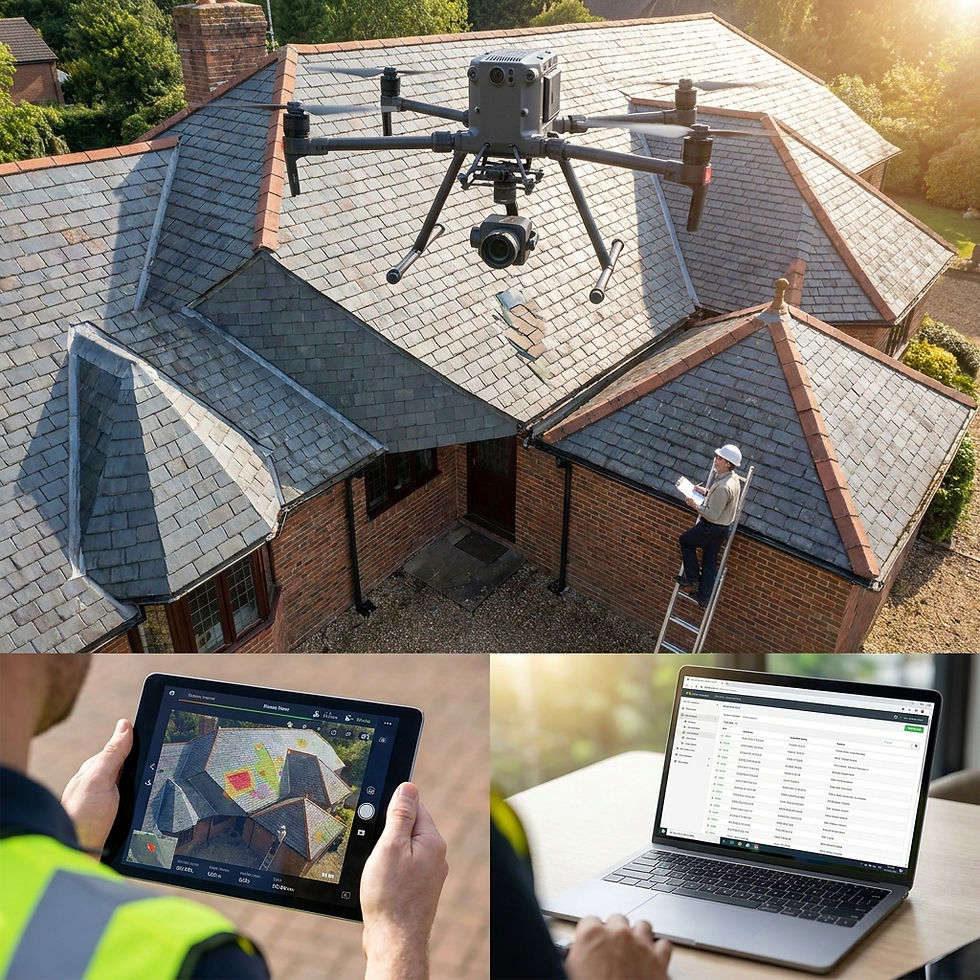
Drone project documentation creates a consistent, time-stamped visual record of a site throughout the life of a project. Using repeatable flight paths and georeferenced imagery, it helps contractors, engineers, insurers, and property owners verify conditions, track progress, support inspections, and reduce disputes long after the flight is complete.

The Paper Trail Went Airborne
Most projects today involve more stakeholders than they used to.
Owners are remote. Insurance carriers want documentation. Municipalities expect cleaner records. Contractors are expected to validate progress. Timelines move fast enough that disputes can surface before people even realize there’s a disagreement.
That creates pressure for consistent documentation.
Not polished marketing footage. Actual records.
Aerial inspection services increasingly function as part of broader verification workflows across construction, roofing, infrastructure, and property management. Aerial data collection fills that gap because it captures site conditions in a repeatable way.
The same location can be documented over time using consistent flight paths, timestamps, and measurable imagery. Suddenly, questions that once relied on memory start relying on records instead.
Questions like:
Was the material already delivered?
Did site conditions delay the work?
Was that damage pre-existing?
Did the grading change after rainfall?
Was the repair actually completed?
Those are no longer casual conversations. They are operational questions with financial consequences attached to them.
When Documentation Answers the Question
Business Question | Drone Record Needed | Business Risk Reduced |
Was the work completed on schedule? | Time-stamped progress imagery | Schedule disputes |
Was damage already present? | Before-and-after aerial documentation | Insurance disagreements |
Did grading or site conditions change? | Orthomosaic comparison | Earthwork disputes |
Was the roof repaired correctly? | Roof inspection imagery | Warranty disputes and maintenance liability |
Did materials arrive before delays? | Weekly progress documentation | Contract and payment disputes |
Visibility Isn’t the Same Thing as Verification
This is where many companies misunderstand commercial drone services.
Good visuals are useful. Nobody’s arguing otherwise. But usable aerial deliverables matter far more when the information needs to support decisions later.
A drone roof inspection, for example, has value because it captures site conditions at a specific moment in time. In confined, interior, or difficult-to-access environments, specialized workflows such as FPV aerial inspection services can document conditions traditional inspection methods may struggle to capture efficiently. When done properly, that information becomes part of the project history.
That’s very different from simply taking aerial photos.
The same applies to construction progress documentation. Weekly flights are no longer just “nice updates” for stakeholders. Increasingly, they function as a running historical archive of site activity, sequencing, material staging, and visible progress.
Reality capture workflows are becoming part of standard project oversight because they create a reviewable site history long after work is complete. Every project generates a record—whether teams intentionally manage it or not. The companies adapting fastest are treating documentation as part of the workflow, not an afterthought.
Accountability Changed the Workflow
One of the biggest shifts in recent years is how aerial documentation is being used after the flight.
Insurance carriers review it. Project managers reference it during disputes. Engineers compare conditions over time. Property owners use it to validate contractor work. Legal teams sometimes request it months after a project wraps.
That changes how drone inspection services are approached operationally.
Consistency matters more than cinematic shots. Repeatability matters more than dramatic angles. Reliable geospatial data matters more than flashy edits.
Frankly, some of the most valuable drone work today looks fairly boring to the average person.
Straight-down orthomosaic captures. Structured site progress flights. Repeat inspection paths. Controlled overlap. Clean metadata.
Not the sort of thing ending up in a sizzle reel.
But when someone needs to verify what happened on a site three months earlier, boring suddenly becomes extremely useful.
The Industry Quietly Changed Its Expectations
There wasn’t one dramatic turning point where companies collectively decided aerial verification mattered.
The shift happened gradually.
Projects became more scrutinized. Insurance claims became more detailed. Remote collaboration became normal. Documentation expectations increased. Stakeholders wanted faster answers with fewer gray areas.
The conversation has shifted toward using drones to verify project conditions, timelines, and documented site activity rather than simply capture visuals from above.
Eventually, “trust me” stopped being sufficient documentation.
That pressure created demand for reality capture workflows that produce consistent, defensible records without slowing projects down.
And that’s where drones became operational tools instead of novelty technology.
The interesting part is that many industries no longer treat aerial documentation as innovative. They treat the absence of documented aerial data as the risk.
That’s a very different mindset.
The Record Matters More Than the Flight
The drone itself still gets most of the attention. It’s the visible part. The bit everyone notices standing on-site.
But the real value usually shows up later.
When someone needs to verify conditions.
When a timeline gets questioned.
When a dispute surfaces.
When a project team needs to look backward instead of forward.
That’s where structured aerial documentation earns its place.
Good Documentation Creates Better Decisions
The value of drone documentation isn't measured by the flight itself—it's measured by how confidently project teams can answer questions weeks or months later. The stronger the record, the fewer assumptions everyone has to make.
Better Documentation Starts With Better Operations
As documentation standards continue to rise, pilot skill is only part of the equation. Consistent capture, repeatable workflows, airspace awareness, quality control, and usable deliverables all depend on disciplined operational processes.
That’s one reason Extreme Aerial Productions also offers drone pilot training designed around real-world commercial operations, not just passing a test.
Documentation Is Easier to Plan Than Recreate
Whether you're managing construction projects, roof inspections, insurance claims, or ongoing property documentation, building the right documentation workflow before the first flight is far easier than trying to recreate missing evidence later.
Request documentation support, and we'll help you build a repeatable aerial documentation workflow that fits your project, inspection, or long-term monitoring needs.


Comments