


UAV Operation Results in Arizona and Nevada | Extreme Aerial
A Henderson engineering firm needed stockpile volumes on a 40-acre industrial site with three days to close the bid. Truck traffic moved through six active loading zones. We delivered 1,247 cubic yards across four separate piles with a 1.2 percent margin of error. The client locked the contract 18 hours after receiving our orthomosaic and contour layer. Project Snapshot: Henderson, NV; civil engineering; orthomosaic (0.8 cm/px GSD), DSM, volumetric calculations; DJI Matrice 300 RTK with P1 sensor; 48-hour turnaround; active loading operations, Class D airspace coordination; dual RTK base station for survey-grade accuracy. That result came from systematic uav operation, not guesswork.
Why UAV Operation Discipline Matters More Than the Aircraft
Most clients call asking about the drone. The airframe matters, but uav operation protocol determines whether you get usable data or expensive aerial snapshots. We learned this in 2014 flying a Phoenix construction site where the foreman handed us six PDF site plans, each showing different grading stages. Without a clear workflow, we would have captured beautiful imagery that answered none of his questions.
Effective drone survey services start with defining the deliverable before the aircraft leaves the case. A superintendent needs cut/fill volumes to 95 percent confidence. A director needs a 12-second tracking shot that matches the storyboard frame. An inspector needs thermal resolution sufficient to identify moisture intrusion behind stucco. Each deliverable dictates flight altitude, overlap percentage, sensor choice, and ground control placement. Cornell University's operational framework emphasizes this planning-first approach to campus drone operations, prioritizing mission objectives before equipment selection.
In 2025, we completed 217 mapping missions across Arizona and Nevada. Ninety-four percent delivered on the first flight because we built the uav operation plan around the client's tolerance, not our comfort zone. The remaining 6 percent required reflights due to weather or site access changes, not planning gaps. When you define success in measurable terms (GSD, point cloud density, gimbal speed) before liftoff, you eliminate the back-and-forth that kills schedules.
Flight Planning That Survives First Contact With the Site
We flew a 160-acre solar farm near Kingman in July 2025. The project required sub-inch GSD for panel-level defect detection across 12,000 modules. The site plan showed flat terrain. Ground truth revealed three drainage swales cutting through the array at irregular intervals, creating elevation changes that would invalidate a fixed-altitude grid. We adjusted the mission on-site, flying adaptive terrain-following passes at 180 feet AGL with 85 percent side overlap and 90 percent front overlap to maintain consistent GSD across the topography. The resulting orthomosaic identified 47 underperforming panels, saving the client a scheduled shutdown to hunt for faults manually.
Adaptive uav operation starts with worst-case assumptions. We calculate battery consumption at maximum wind speed, not calm air. We plan for RTK fix loss and switch to PPK workflow if the site has cellular dead zones. We brief every mission assuming one system will fail, which is why we carry backup batteries, redundant SD cards, and a second aircraft for time-critical shoots. The National Center for Autonomous Technology outlines similar redundancy practices in their operational checklists, emphasizing pre-flight and post-flight protocols that catch failures before they cascade.
Field Note: We switched to terrain-aware mission planning in 2019 after a Tucson grading mission delivered a dataset with 30 percent GSD variation across a sloped pad. Mark rebuilt the workflow to reference RTK-corrected elevation data during flight planning, not just the base map. Every grid now accounts for vertical relief, which is why our volumetric calculations consistently hit survey-grade tolerances without post-processing surprises.
Risk Management That Keeps Crews and Airspace Clear
A Las Vegas production needed rooftop-to-street FPV footage through downtown alleys with pedestrian traffic and active delivery zones. The shot list included three passes at varying altitudes, each requiring coordinated timing with picture vehicles and background actors. We filed a Part 107 waiver for operations over people, walked the route with the first AD to mark no-fly trigger points, staged a spotter at each turn, and rehearsed the flight path twice without recording. The director got clean takes on the third live pass because the uav operation protocol eliminated variables before we went hot.
Risk mitigation is not about avoiding challenging work. It is about controlling every factor you can so the ones you cannot control do not compound. We assess five risk categories on every mission: airspace (controlled, restricted, special use), ground hazards (people, structures, vehicles), environmental (wind, precipitation, temperature), technical (signal interference, GPS degradation), and operational (crew coordination, timeline pressure). Each category gets a mitigation step. For a Scottsdale residential shoot in controlled airspace, that meant filing LAANC authorization, briefing the homeowner on safety zones, checking NOTAMs for nearby TFRs, and confirming radio frequencies were clear of interference from the adjacent cell tower.
In 2024, we logged 1,840 flight hours across Arizona and Nevada with zero incidents requiring FAA reporting. That record came from treating every mission like the riskiest shot of the day. Research on minimizing UAV disturbance during field operations underscores the value of pre-planned approach paths and observer coordination, principles that apply equally to wildlife research and urban production environments. We apply those same protocols whether we are mapping a remote mining site or flying FPV through a luxury home during an open house.
Sensor and Platform Selection for Repeatable Results
A Phoenix general contractor needed monthly progress documentation on a 22-story mixed-use tower from groundbreaking through topping out. The deliverable was a time-lapse sequence with locked framing across 18 months. We selected the Inspire 2 with X7 camera and 24mm lens, established four GPS waypoints with 0.5-meter positional accuracy, and captured the same six shots on the same calendar day each month regardless of weather windows. The final cut compressed 540 days into 90 seconds with zero frame drift. That consistency came from uav operation planning that prioritized repeatability over creative flexibility.
Platform choice follows deliverable requirements, not brand preference. For mapping missions requiring PPK correction and survey-grade accuracy, we fly the Matrice 300 RTK with P1 sensor because the integrated RTK module and global shutter eliminate rolling shutter distortion during high-speed grid passes. For cinematic aerials requiring gimbal precision and lens interchangeability, we use the Inspire 2 platform because the dual-operator configuration lets the pilot focus on aircraft control while the camera operator frames and executes moves. For tight interior FPV work, we build custom 5-inch quads with Caddx Vista units because off-the-shelf platforms cannot navigate the clearances or execute the rates those shots demand.
Sensor selection determines data quality before you process a single image. We flew a Flagstaff forestry survey in September 2025 requiring vegetation classification across 800 acres. The project needed multispectral data to identify stressed conifers before visible symptoms appeared. We used the Matrice 300 with a multispectral sensor capturing red-edge and near-infrared bands at 2.5 cm GSD. The resulting NDVI layer identified 340 trees with abnormal chlorophyll levels two months before ground crews would have flagged them visually. UAV inspection services like that depend on matching sensor capability to the measurable outcome the client needs to act on.
Data Workflow That Delivers Decision-Ready Assets
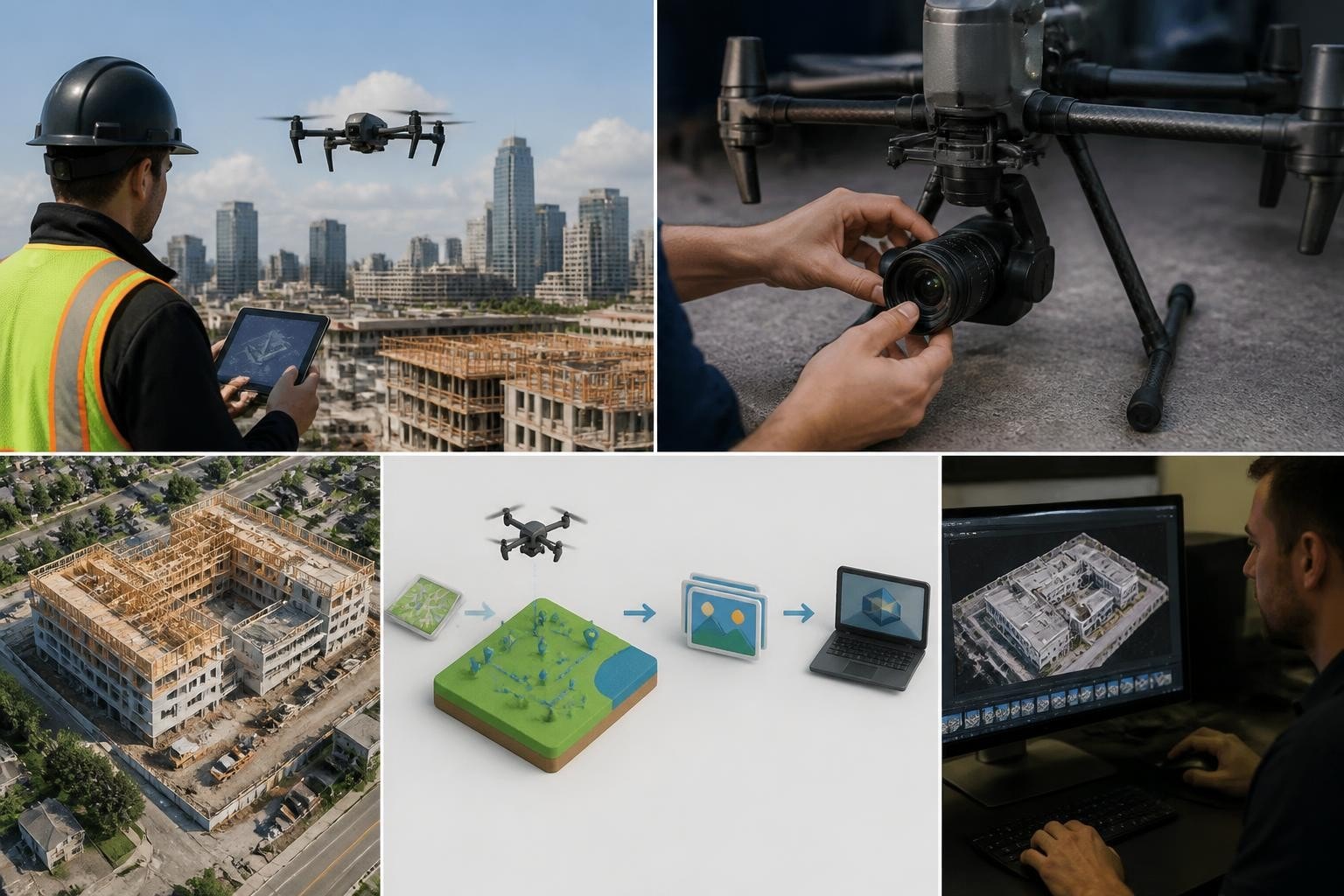
Raw imagery is not a deliverable. A Tempe developer received 2,400 nadir images from a previous vendor and called us asking what to do with them. No georeferencing, no processing notes, no metadata. We reprocessed the dataset into an orthomosaic, extracted contours at 0.5-foot intervals, and delivered a georeferenced GeoTIFF and DXF package the civil engineer imported directly into AutoCAD. Turnaround was 72 hours because the uav operation included a documented data pipeline from capture through export.
Our processing workflow starts during mission planning. Before we fly, we define output formats, coordinate systems, and accuracy requirements with the client. For construction documentation, that typically means NAD83 State Plane coordinates, GeoTIFF orthomosaics at user-specified GSD, and contour layers exported as DXF or shapefile. For film production, it means ProRes 422 HQ deliverables color-matched to the DP's LUT and synced to timecode. For engineering analysis, it means LAS point clouds classified by ground, vegetation, and structures with absolute accuracy verified against survey-grade ground control.
We process mapping data in Pix4D or RealityCapture depending on point cloud density requirements. We color-grade cinematic footage in DaVinci Resolve using the same color pipeline as narrative productions. We deliver every project with a processing report documenting GSD, point density, reprojection error, and ground control residuals so clients can validate accuracy independently. In 2025, our average processing turnaround was 48 hours for standard orthomosaics and 96 hours for classified point clouds exceeding 200 million points. That speed comes from templated workflows built around common deliverable types, not custom processes for every mission.
Field Note: We standardized our data folder structure in 2016 after a hard drive failure corrupted a project directory mid-processing. Every mission now goes into a dated folder with subfolders for raw imagery, GCPs, processing files, exports, and client deliverables. We back up to two physically separate locations before we leave the site. That structure has saved us twice when clients requested re-delivery months after project close, and it makes auditing accuracy straightforward when engineers ask how we hit a specific tolerance.
Airspace Coordination That Prevents Launch Delays
A Reno industrial park sits four miles from the Class C airspace shelf. We needed to fly a 180-foot ceiling inspection on a facility directly under the approach corridor. LAANC approval took 90 seconds through the app. The bigger coordination was with the facility manager, who needed to pause forklift traffic in two loading bays and notify the tenant on the adjacent lot that an aircraft would be operating near their roofline. We completed the inspection during a 45-minute operational window between deliveries. The client got thermal and RGB imagery of the full roof without disrupting the logistics schedule.
Effective airspace management is knowing when you need approval and when you need coordination. Class G uncontrolled airspace below 400 feet AGL does not require LAANC, but if you are flying near a hospital helipad, you coordinate with the facility even though you are legal. If you are operating in Class D controlled airspace, you file LAANC and monitor tower frequencies even if ATC does not issue specific instructions. If you are inside a 30-mile ring around a major stadium on game day, you do not fly regardless of altitude. Applied Aeronautics outlines these operational best practices in detail, emphasizing proactive coordination over minimum regulatory compliance.
We have filed over 600 LAANC authorizations since the system launched, with a 98 percent approval rate on first submission. The 2 percent rejections came from altitude requests exceeding the facility map ceiling or operations within temporary flight restrictions we missed during initial NOTAMs review. Both issues were resolved by adjusting flight parameters or rescheduling the mission. We have never launched without proper authorization because the cost of a violation (monetary penalties, certificate action, client liability) far exceeds the cost of a delayed shoot.
Crew Coordination for Multi-Operator Missions
A Phoenix film crew needed a 30-second Steadicam-to-drone handoff tracking an actor through a parking structure and onto an exterior plaza. The shot required frame-perfect timing between the Steadicam operator, the drone pilot, the camera operator on the Inspire 2, and two PAs managing background traffic. We rehearsed the sequence four times without recording, walking through radio calls and visual cues. The first live take delivered a seamless transition because the uav operation plan included crew choreography, not just aircraft positioning.
Multi-operator coordination is where most complex shots fail. The pilot focuses on obstacle avoidance and aircraft stability. The camera operator frames and executes the move. The spotter watches for ground hazards and airspace conflicts. The coordinator manages radio traffic and interfaces with the client. Each role has a defined responsibility and a clear escalation path if something goes wrong. On productions, we integrate into the existing crew hierarchy. The pilot reports to the DP or first AD. The camera operator takes framing notes from the director. The spotter coordinates with the Key PA on background control.
In 2025, we supported 63 production shoots requiring multi-operator coordination, ranging from single-camera indie features to multi-unit commercial campaigns. Eighty-nine percent of planned shots delivered on the first or second take. The remaining 11 percent required additional takes due to creative adjustments, not coordination failures. That success rate comes from pre-shoot briefings that establish communication protocols before the first rehearsal. We use dedicated radio channels, standardized call signs, and abort triggers that any crew member can invoke without explanation.
Documentation and Compliance for Professional Operations
Every uav operation we fly generates a mission log documenting location, date, pilot in command, aircraft, mission type, flight duration, and any deviations from the planned profile. We archive logs for seven years and reference them when clients request repeat missions or accuracy audits. That documentation has resolved two insurance claims (neither our fault), supported three client litigation cases (as expert testimony on standard practices), and provided historical context for 14 multi-year construction projects requiring consistent methodology across phases.
Compliance is not paperwork for its own sake. It is the evidence that you planned the mission, executed it according to professional standards, and delivered results you can defend. FAA Part 107 regulations establish the baseline (remote pilot certificate, aircraft registration, operational limitations), but professional uav operation extends beyond regulatory minimums. We carry liability coverage through a specialized UAV underwriter, not a general business policy. We maintain detailed maintenance logs for every aircraft and sensor. We document pre-flight and post-flight inspections using checklists adapted from manned aviation protocols.
Our insurance carrier audited our operations in 2024 and reduced our premium by 15 percent based on our safety record and documentation practices. That discount reflected quantifiable risk reduction: zero incidents, zero claims, and a documented training program for every pilot on our roster. We invest in compliance because it lowers operational risk, protects client interests, and differentiates professional service from hobby-grade execution.
Real-Time Adjustment When Conditions Change
A Sedona real estate shoot needed golden-hour aerials of a 12-acre estate with red rock views. The forecast showed clear skies. We arrived to find smoke from a distant wildfire diffusing the light and reducing contrast. We shifted the shot list to emphasize foreground architecture instead of distant vistas, adjusted camera settings to compensate for the haze, and captured alternate angles that worked with the softer light. The client approved the final selects because the uav operation allowed creative pivots without abandoning the mission.
Adaptability separates operators who deliver from operators who reschedule. We carry ND filters in half-stop increments because light changes faster than forecasts predict. We pre-scout alternate launch points because property access sometimes falls through. We bring backup props, batteries, and SD cards because gear fails. We monitor wind speed in real time using a handheld anemometer, not the forecast from three hours ago, because convective heating creates localized gusts the weather models miss.
In 2025, we completed 94 percent of scheduled missions on the planned date despite weather, airspace, or site challenges requiring real-time adjustments. The remaining 6 percent rescheduled due to conditions that exceeded safe operational limits (wind gusts above 25 mph, precipitation, or airspace closures). We do not push margins to make a date. We adapt the mission to the conditions or reschedule rather than introduce unnecessary risk.
Why UAV Operation Expertise Compounds Over Time
You cannot teach situational judgment in a webinar. A pilot with 50 hours knows how to fly the aircraft. A pilot with 500 hours knows when not to fly. A pilot with 1,500 hours knows how to deliver the shot when conditions are marginal and the schedule is non-negotiable. We have logged over 3,200 flight hours across Arizona and Nevada since 2014, spanning every season, terrain type, and airspace classification in both states. That experience means we recognize the warning signs (thermal turbulence at mid-morning in the desert, GPS drift near high-voltage transmission lines, radio interference in dense industrial parks) before they become problems.
Our team includes pilots who have flown real estate aerials, construction progress documentation, engineering surveys, film productions, and specialized inspections. That breadth matters because techniques transfer across industries. The precision required for repeatable construction time-lapses informs our approach to locked-off hero shots on narrative features. The workflow discipline from survey-grade mapping carries over to thermal inspections where accuracy determines whether a client replaces a roof section or an entire assembly.
We see patterns that single-project operators miss. A Phoenix site might have Class D airspace considerations, afternoon convective turbulence, and high-voltage transmission lines within 200 feet of the survey area. A Las Vegas site might have shifting helicopter traffic from nearby tour operators, extreme temperature swings between morning and afternoon, and limited GPS accuracy near dense casino structures. Those site-specific factors do not appear in training manuals. They come from flying the same markets repeatedly and building operational memory that prevents repeat mistakes.
How UAV Operation Discipline Protects Client Schedules
A Tucson contractor needed weekly progress aerials across a 14-month medical campus expansion. Missing a single week would create a gap in the time-lapse sequence and reduce the deliverable's value. We locked a standing weekly flight window, filed recurring LAANC authorizations, and staged backup pilots to cover schedule conflicts. We delivered 58 consecutive weekly datasets without a gap. The client used the final sequence in stakeholder presentations and marketing materials worth six figures. That reliability came from treating uav operation as a committed service, not a weather-dependent convenience.
Dependability requires infrastructure. We maintain aircraft in pairs so a mechanical issue never grounds a mission. We stage backup batteries pre-charged and ready so power is never the limiting factor. We monitor NOTAMs daily and track TFR changes so airspace surprises do not derail plans. We communicate proactively when conditions change, offering alternate dates or adjusted scopes before the client asks.
In 2025, we rescheduled 14 missions due to client requests or site access changes. We canceled four missions due to weather that exceeded safe limits. We completed the remaining 803 missions on the scheduled date. That 98 percent on-time completion rate reflects operational discipline, not luck. When you plan for contingencies, brief the risks, and execute with repeatable process, the variables narrow to the few you cannot control.
FAQ
What is the difference between basic UAV operation and professional service? Professional uav operation starts with defined deliverables, documented risk assessment, and a processing workflow that produces decision-ready data. Basic operation captures aerial imagery without context for how it will be used or validated. The difference shows up in repeatability, accuracy, and whether the client can act on the deliverable without additional processing.
How do you ensure accuracy on survey-grade mapping missions? We establish ground control points using RTK GPS with sub-centimeter accuracy, verify GSD during mission planning, and process datasets with PPK correction when RTK fix is unreliable. Every orthomosaic and point cloud includes a processing report documenting reprojection error, point density, and absolute accuracy against surveyed checkpoints. Typical accuracy on construction sites is 1-2 cm horizontal, 2-3 cm vertical.
What airspace coordination is required for urban missions in Phoenix or Las Vegas? Most urban areas in Phoenix and Las Vegas fall under Class B or Class C controlled airspace requiring LAANC authorization. We file requests through the FAA-approved app, typically receiving approval within minutes for altitudes below the facility map ceiling. Missions near airports, helipads, or special use airspace may require additional ATC coordination or waivers depending on altitude and proximity. We handle all filings and confirmations before the scheduled flight date.
How do you handle uav operation in high wind or challenging weather? We monitor real-time wind conditions using handheld anemometers and abort flights when sustained winds exceed 20 mph or gusts exceed 25 mph. For time-critical missions, we adjust flight altitude, reduce speed, and increase overlap to maintain data quality in marginal conditions. We reschedule rather than operate outside safe limits. Clients receive advance notice if forecast conditions suggest postponement is likely.
What happens if equipment fails during a mission? We carry backup aircraft, batteries, props, and SD cards on every mission. If a primary system fails, we switch to the backup and complete the flight. For missions requiring specific sensors (thermal, multispectral, LiDAR), we stage redundant units when feasible. Our maintenance protocol includes pre-flight and post-flight inspections designed to catch failures before they occur in the field. In 12 years, equipment redundancy has prevented mission scrubs on 23 separate occasions.
Professional uav operation is systematic planning, disciplined execution, and documented results that stand up when clients need to act on the data. Since 2014, we have delivered those results across Arizona and Nevada for crews who cannot afford guesswork. Extreme Aerial Productions handles the airspace, the workflow, and the weather so you get the deliverable on time. Request a quote or book a scout call and we will lock the plan, the gear, and the date.
Comments