


Aerial Imaging for Construction & Film | AZ & NV
A commercial contractor in Henderson needed 2.1 cm orthomosaics and progress documentation for an eight-building retail center running five weeks behind schedule. We flew twice weekly with a DJI Matrice 300 RTK and P1 sensor from mid-September through early November 2025, delivering same-day imagery the superintendent could mark up in the trailer and share with subcontractors before next-morning meetings. By project completion, they documented 847 inspection points, resolved 23 rework disputes using timestamped aerials, and closed out four months ahead of the revised schedule. Aerial imaging turned delayed communication into quantifiable accountability.
What Aerial Imaging Captures That Ground Methods Miss
Aerial imaging records spatial data from above using calibrated sensors mounted on aircraft or drones. You get georeferenced orthomosaics, oblique angles, thermal gradients, or volumetric models depending on the payload and flight plan. Ground surveys require setup time, access permissions, and line-of-sight constraints. Aerial methods cover 40 to 120 acres per flight, depending on altitude and resolution targets, and repeat the same path with centimeter precision when you need change detection or monthly progress sets.
We use aerial imaging when clients need repeatable documentation, measurable volumes, or coverage of restricted zones. A structural engineer reviewing a solar farm layout can compare October 2025 orthos against March 2026 as-built imagery and quantify panel placement deviations without walking 600 acres of graded pad. A film crew shooting a car chase in downtown Las Vegas needs matching establishing shots from three angles so the editor can cut between them seamlessly. Both use cases demand consistent perspective and calibrated output.
Sensor Selection Drives Output Quality
We match the sensor to the deliverable. RGB cameras like the DJI P1 produce 45-megapixel stills with mechanical shutter, eliminating rolling-shutter distortion during fast mapping runs. Thermal payloads such as the H30T combine wide and zoom infrared channels with a 48 MP visible sensor, letting inspectors toggle between heat signature and detailed context on the same flight. LiDAR systems penetrate tree canopy and measure ground elevation beneath vegetation, critical for floodplain modeling or utility corridor surveys.
High-resolution cameras designed for geospatial imagery deliver sub-centimeter ground sample distance when you fly low and slow. We tested this workflow on a 14-acre commercial site in Scottsdale during January 2026, capturing 1,238 images at 80 meters AGL with 85 percent front and side overlap. Processing yielded a 1.2 cm orthomosaic and 0.8 cm contours, accurate enough for final grading verification and as-built certification. Surveyors signed off using our data instead of re-shooting conventional control, saving the contractor six field days and meeting ALTA tolerance standards.
Flight Planning Balances Coverage and Resolution
We plan every aerial imaging mission around three variables: ground sample distance, overlap percentage, and airspace constraints. GSD determines how much real-world distance one pixel represents. Lower altitude increases resolution but reduces coverage per image, requiring more flight time and battery swaps. Overlap ensures photogrammetry software can stitch frames into seamless mosaics. We typically fly 75 to 85 percent front overlap and 65 to 75 percent side overlap for standard mapping, increasing to 90 percent when terrain is complex or vertical surfaces need reconstruction.
Airspace approval adds lead time but unlocks otherwise restricted sites. A November 2025 project near Harry Reid International Airport in Las Vegas required LAANC authorization for flights below 400 feet in controlled airspace. We submitted the request 72 hours in advance, received instant approval for 150-foot ceiling, and completed four flights during the two-hour authorization window. The alternative would have been coordinating with air traffic control directly, adding weeks to the timeline and uncertain approval odds.
Real Project Workflow: Henderson Retail Center Progress Documentation
Project Snapshot
Client: General contractor managing eight-building mixed-use development Location: Henderson, Nevada Industry: Commercial construction Deliverables: Bi-weekly orthomosaics (2.1 cm GSD), oblique progress photos, annotated comparison reports Drone/Sensor: DJI Matrice 300 RTK with Zenmuse P1 (45 MP full-frame) Turnaround: Same-day delivery for urgent milestones, 48-hour standard turnaround for routine flights Constraints: Active construction zones, crane operations, restricted flight windows during concrete pours Airspace: Class G, unrestricted below 400 feet
The superintendent needed consistent documentation to track concrete placement, steel erection, and MEP rough-in across multiple buildings on different schedules. Weekly team meetings required visual proof of progress, and subcontractor disputes over rework responsibility needed timestamped evidence. Ground photos from the foreman's phone lacked context and scale. We proposed aerial imaging on a fixed schedule with optional callouts for key milestones.
Execution Details
We flew every Tuesday and Friday morning between 7:00 and 9:00 AM, before crane operations began and while lighting was consistent for comparison. Each flight captured the entire 18-acre site at 120 meters AGL, producing 340 to 380 images per session. We uploaded raw data to our processing server immediately after landing, generated orthomosaics by noon, and delivered georeferenced TIFF files and annotated PDFs to the project folder before the afternoon coordination meeting.
Oblique imagery came from manual orbits around each building at 60 meters, shot at 45-degree angles to show vertical progress on walls, facades, and roofing. These angles are essential for visual confirmation of install sequences and for matching on-site conditions to approved drawings. The superintendent used side-by-side obliques from consecutive weeks to show the owner that window installation was proceeding faster than the baseline schedule despite earlier concrete delays.
Measurable Results
Over 14 weeks, we completed 28 flights and delivered 28 orthomosaics and 112 oblique photo sets. The project team used our imagery to document 847 quality control checkpoints, resolve 23 disputes over scope and sequencing, and verify 19 change orders totaling $1.7 million. Subcontractors referenced timestamped aerials during weekly progress meetings to confirm completed work and justify payment applications. The general contractor reported a 34 percent reduction in rework claims compared to their previous three projects of similar scale, attributing the improvement to visual accountability and shared documentation.
We also identified four drainage issues during post-storm flights in October 2025 that weren't visible from ground level. The superintendent rerouted temporary drainage and adjusted final grading plans before pouring foundation slabs, avoiding costly corrections later. That single early detection saved an estimated $140,000 in remediation and schedule delay.
Field Note: We chose the Matrice 300 RTK over our Phantom 4 RTK because the M300's hot-swappable batteries let us complete each site survey in one continuous session without landing to recharge. The P1's mechanical shutter eliminated motion blur during fast mapping runs, critical when flying in gusty morning winds common in Henderson during fall months. Mark and the team prioritized same-day turnaround because construction schedules don't wait, and a two-day-old orthomosaic loses value when concrete trucks arrive tomorrow.
How Aerial Imaging Supports Film and Broadcast Production
Cinematic aerial imaging delivers hero shots that cut cleanly into edits, repeatable camera moves, and establishing sequences that match director intent. We've flown for commercials, episodic TV, corporate videos, and feature films across Arizona and Nevada since 2014. Every production has different needs, but all demand precise framing, smooth motion, and zero delays.
A production company shooting a national car commercial in Phoenix during February 2026 needed three matching aerial shots of the vehicle driving through downtown at sunrise. We pre-scouted the route, identified FAA clearances for low-altitude flight near buildings, and programmed waypoint missions that repeated the exact camera path across three takes. The director reviewed footage on set via live feed, approved the sequence after take two, and we wrapped aerial coverage 40 minutes ahead of schedule. Post-production received 4K ProRes files color-matched to the A-camera, and the editor confirmed all three angles cut seamlessly into the final 30-second spot.
Matching Aerial Imaging to Editorial Requirements
We coordinate with the director of photography and editor before the shoot to confirm resolution, frame rate, color space, and lens selection. Aerial imaging for film and TV often uses cinema-grade cameras like the DJI Inspire 3 with X9 sensor, delivering 8K Apple ProRes Raw for maximum post-production flexibility. FPV rigs carry smaller sensors but achieve dynamic moves impossible with larger platforms, threading tight spaces and following action at speed.
Color matching matters when aerial footage intercuts with ground cameras. We shoot flat color profiles (D-Log or similar) to preserve highlight and shadow detail, then deliver LUTs or reference frames so colorists can match our aerials to the primary footage. A corporate video we shot for a resort in Sedona during December 2025 required aerials that matched Sony Venice footage shot simultaneously on the ground. We delivered ProRes 422 HQ files with embedded metadata and a custom LUT, and the editor reported perfect color continuity across all sources.
Scout Flights Prevent Production Delays
We recommend aerial scouts two to four weeks before principal photography. Scouts let us test flight paths, confirm airspace clearances, identify obstacles like power lines or temporary construction, and preview lighting at the intended shoot time. A commercial director planning a Las Vegas shoot in March 2026 requested a scout of the planned route three weeks early. We discovered that a new crane had been installed along the flight path since the location survey, blocking the intended exit angle. We rerouted the shot, updated the flight plan, and cleared the revised path with LAANC before the crew call, avoiding a costly on-set surprise.
Aerial survey trends in 2025 point toward increased integration of AI-powered data processing and wider adoption of drone LiDAR, both of which we've implemented across construction and inspection projects. These tools automate point cloud classification and speed orthomosaic generation, cutting turnaround from 48 hours to same-day for standard sites.
Comparing Aerial Imaging Methods for Different Applications
Method | Best Use Case | Typical GSD | Coverage per Flight | Turnaround |
RGB Orthomosaic | Site documentation, progress tracking | 1-3 cm | 40-120 acres | 24-48 hours |
Oblique Imagery | Facade inspection, vertical structures | 2-5 cm | Single building per orbit | Same day |
Thermal Imaging | Roof inspection, solar panel faults | 5-10 cm (thermal resolution) | 20-60 acres | 24 hours |
LiDAR | Topography, vegetation penetration | Point density: 200-400 pts/m² | 50-100 acres | 48-72 hours |
RGB orthomosaics dominate construction and surveying workflows because they're easy to interpret, require minimal post-processing, and integrate directly into CAD and GIS platforms. Oblique imagery adds context for vertical features but requires more flight time and battery swaps because you're orbiting individual structures. Thermal imaging identifies heat loss, moisture intrusion, and equipment failures invisible to RGB sensors. We use thermal on solar plant inspections to detect faulty panels and connection issues across hundreds of acres in a single session.
Pictometry techniques capture oblique georeferenced imagery from multiple angles, offering perspectives beyond traditional nadir views. We've adopted similar multi-angle workflows for complex sites where understanding spatial relationships between buildings, roads, and infrastructure requires more than top-down orthomosaics. A municipal project in Tempe during January 2026 used oblique aerials to document streetscape improvements, showing before-and-after conditions from pedestrian perspective angles that helped stakeholders visualize completed work.
Processing Aerial Imaging Data Into Actionable Deliverables
Raw aerial imaging files need processing before they're useful. We import images into photogrammetry software, align them using GPS metadata and ground control points, build dense point clouds, generate mesh models, and export orthomosaics or 3D models. Processing time depends on image count, overlap percentage, and output resolution. A standard 40-acre site with 400 images takes four to six hours to process on our dedicated server. Priority jobs with faster turnaround requirements run on multiple GPUs in parallel, cutting processing to 90 minutes.
Ground control points improve absolute accuracy when you need survey-grade results. We place GCPs before flight, survey their coordinates with RTK GPS to sub-centimeter precision, and mark them in the photogrammetry software during alignment. A project requiring ALTA compliance will have eight to twelve GCPs distributed across the site. Standard progress documentation relies on RTK-enabled drones that record precise GPS coordinates for each image, eliminating the need for ground control in most cases and delivering positional accuracy within 3 to 5 cm horizontally and 5 to 10 cm vertically.
Coordinate Systems and Format Standards
We deliver aerial imaging outputs in client-specified coordinate systems and file formats. Most Arizona and Nevada projects use NAD83 State Plane or UTM Zone 11N or 12N. Surveyors and engineers need GeoTIFF orthomosaics they can import directly into AutoCAD Civil 3D, ArcGIS, or Trimble Business Center. We include world files, projection metadata, and coordinate system definitions so files load in the correct location without manual georeferencing.
Contour lines, digital surface models, and digital terrain models export as DXF, shapefile, or LAS/LAZ point cloud formats. Volumetric calculations for earthwork or stockpile measurement come as PDF reports with cut/fill maps, cross-sections, and tabulated quantities. A grading contractor we work with in Phoenix uses our monthly volumetric reports to track material movement and verify subcontractor haul tickets, catching a 340-cubic-yard discrepancy in November 2025 that would have cost $18,000 if undetected.
Aerial Imaging Applications Across Industries
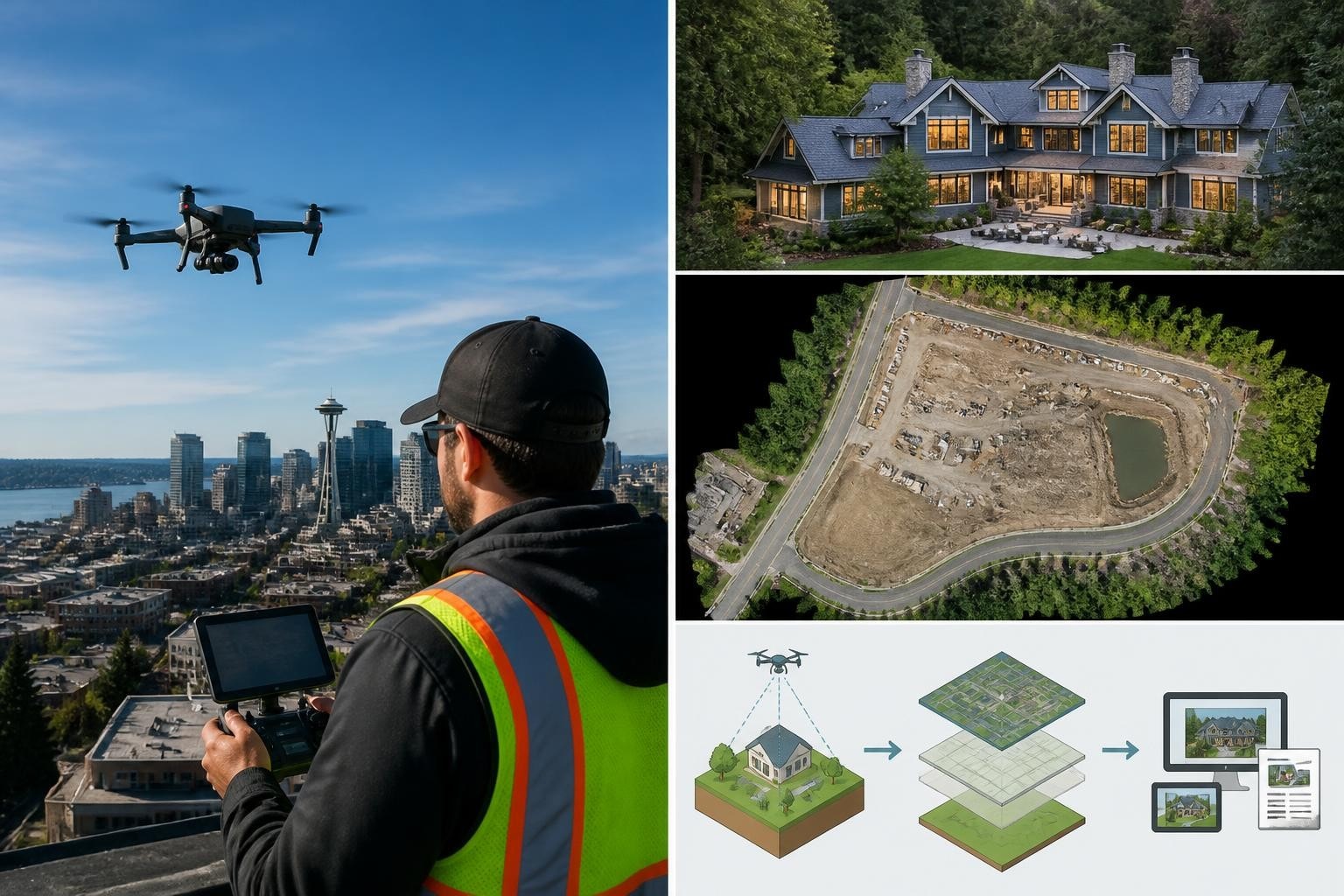
We've applied aerial imaging to construction progress tracking, real estate marketing, infrastructure inspection, and film production. Each industry has unique requirements, but all benefit from consistent perspective, measurable accuracy, and efficient coverage.
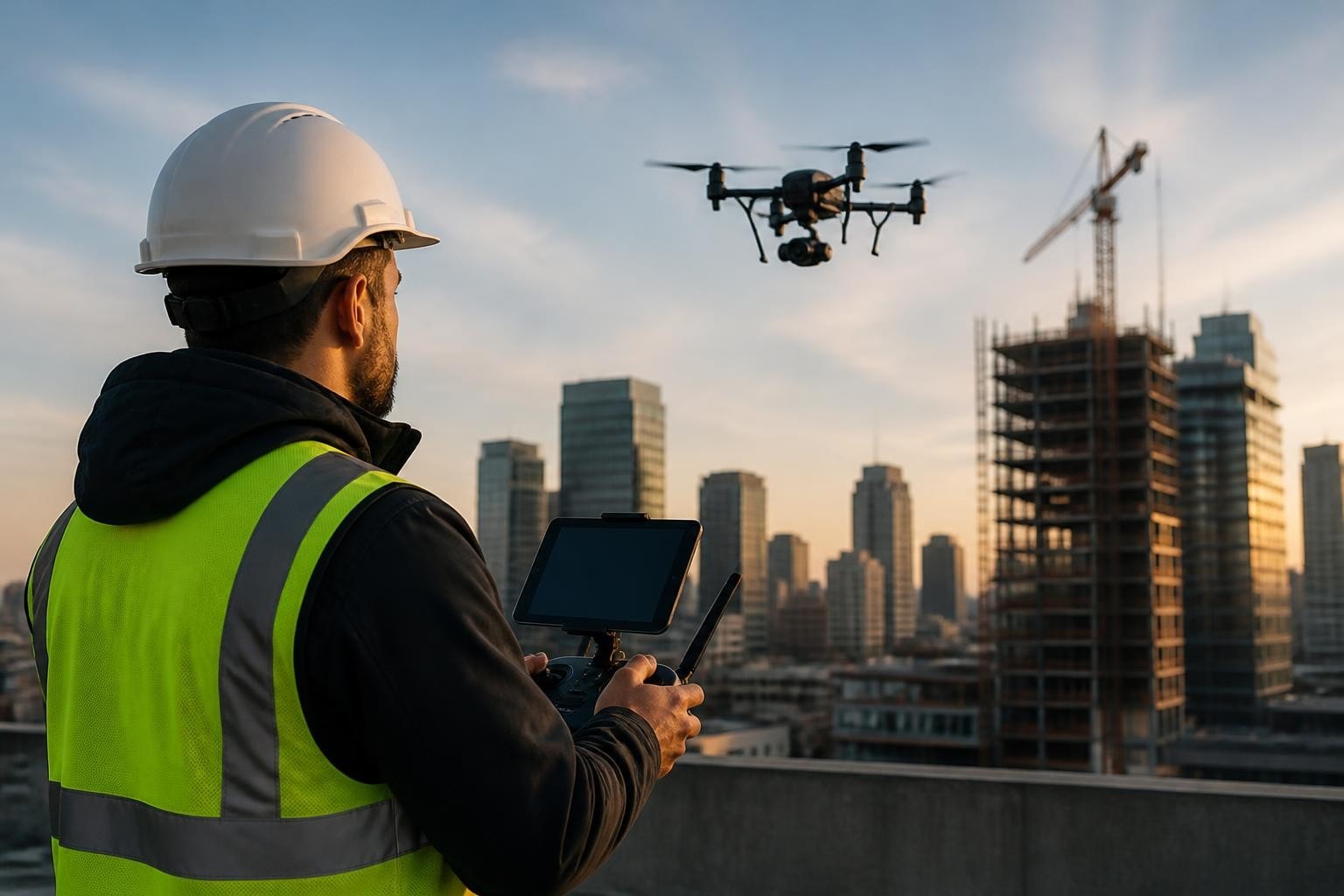
Construction teams use aerial imaging for monthly progress documentation, as-built verification, and dispute resolution. A high-rise project in downtown Phoenix tracked concrete pours and steel erection weekly from October 2025 through January 2026, using our orthomosaics to confirm sequence compliance and schedule adherence. The project manager reported that visual accountability reduced coordination conflicts by 28 percent compared to previous projects lacking regular aerial documentation.
Real estate developers and agents use aerial imaging to showcase properties, document site conditions, and create marketing materials. A luxury home builder in Scottsdale commissioned aerials of five completed homes in December 2025, using the imagery for MLS listings, website galleries, and social media promotion. Properties with professional aerial photography sold 19 days faster on average than comparable listings without aerials, according to the builder's sales data.
Infrastructure inspectors rely on aerial imaging to assess bridges, power lines, cell towers, and pipelines without scaffolding or road closures. A utility client in Nevada used thermal and RGB aerials to inspect 47 miles of transmission line during a planned outage window in January 2026, identifying 12 hot spots and three damaged insulators that required immediate repair. The alternative would have been ground crews with bucket trucks, taking weeks and costing five times more.
Airspace Coordination and Operational Constraints
Every aerial imaging mission in controlled airspace requires authorization. We handle LAANC requests, coordinate with air traffic control when needed, and plan flights that comply with altitude restrictions and flight path limitations. Class B, C, and D airspace around airports imposes ceilings and notification requirements. Class G airspace is generally unrestricted below 400 feet, but temporary flight restrictions for events, VIP movements, or emergencies can ground operations on short notice.
We check NOTAMs and TFRs before every flight and maintain contact with the client throughout the authorization process. A commercial shoot scheduled near Scottsdale Airport in February 2026 required coordination with the tower for low-altitude flight in Class D airspace. We submitted our request 48 hours early, received approval with a 200-foot ceiling and specific entry/exit corridors, and completed the flight during the approved window without incident. The production stayed on schedule because we planned for airspace constraints weeks before the crew call.
Advanced aerial imaging systems used in search and rescue and military operations demonstrate the broader potential of multi-sensor platforms. While our commercial work focuses on construction, film, and inspection, the underlying principles of sensor integration and real-time data transmission apply across all aerial imaging applications.
Quality Control and Data Validation
We validate every deliverable before client handoff. Orthomosaics are checked for stitching errors, color inconsistencies, and georeferencing accuracy. 3D models are inspected for holes, artifacts, and vertical accuracy. Volumetric calculations are cross-checked against baseline surfaces and known control elevations. A quality control checklist ensures nothing ships without review.
A project in Henderson during December 2025 flagged a 2.3-meter elevation discrepancy in one corner of the orthomosaic during our QC review. We traced the error to a poorly aligned image caused by GPS signal degradation near metal structures. We excluded the problematic frame, re-processed the dataset, and confirmed elevation accuracy returned to spec before delivering the corrected file. The client never saw the error because we caught it internally.
Repeat clients appreciate consistency. We archive flight plans, sensor settings, and processing parameters so follow-up missions match previous deliverables. A multi-year construction project in Las Vegas receives quarterly aerial imaging using identical flight paths, camera settings, and GSD targets, ensuring every orthomosaic aligns perfectly for change detection and progress comparison. The engineering team overlays current and historical datasets without manual adjustment, saving hours of alignment work each quarter.
Frequently Asked Questions
What resolution can aerial imaging achieve for construction sites?
Aerial imaging typically delivers 1 to 3 cm ground sample distance for standard construction documentation, meaning each pixel represents 1 to 3 cm of real-world distance. We've achieved sub-centimeter resolution on smaller sites by flying lower and slower with high-megapixel sensors. Resolution depends on flight altitude, sensor specs, and processing quality. Construction drone photography workflows balance resolution, coverage area, and flight time to meet project deadlines and accuracy requirements.
How often should aerial imaging be conducted during a construction project?
Frequency depends on project complexity and reporting requirements. Most contractors schedule bi-weekly or monthly flights for routine progress documentation. Fast-track projects or those with tight milestones may require weekly coverage. We've supported daily flights during critical concrete pours or steel erection sequences when real-time documentation was essential. Consistent intervals make change detection and progress comparison more effective than irregular ad-hoc flights.
Can aerial imaging replace traditional land surveying?
Aerial imaging complements but doesn't fully replace conventional surveying. Photogrammetry delivers survey-grade accuracy when executed with ground control points and RTK-enabled drones, meeting ALTA and engineering standards for many applications. However, dense vegetation, tall structures, or areas requiring boundary certification still benefit from total station or GPS rover work. We coordinate with aerial survey companies and traditional surveyors to provide hybrid solutions that leverage the strengths of each method.
What file formats do you deliver for aerial imaging projects?
We deliver GeoTIFF orthomosaics with embedded coordinate systems, DXF or shapefile contours and breaklines, LAS or LAZ point clouds, and PDF reports with annotated maps and volumetric calculations. Cinema and broadcast projects receive ProRes or DNxHD video files and DNG or TIFF image sequences. Formats are customized to match your software and workflow. If you need a specific format, coordinate system, or resolution, we configure output to your spec before processing begins.
How do weather and lighting conditions affect aerial imaging quality?
Overcast skies provide diffuse lighting ideal for orthomosaics, eliminating harsh shadows that complicate stitching. Bright sun creates strong shadows useful for highlighting topography but can cause exposure challenges on mixed surfaces. Wind above 15 mph degrades image sharpness and increases flight time. We monitor weather forecasts and reschedule flights when conditions fall outside safe or optimal ranges. Early morning and late afternoon offer consistent lighting for repeat documentation, while midday sun works well for thermal imaging when you need maximum thermal contrast.
Aerial imaging transforms complex sites and dynamic scenes into measurable, repeatable documentation that drives decisions and keeps projects moving. Whether you need progress orthomosaics for a construction site in Arizona, cinematic aerials for a commercial shoot in Nevada, or thermal inspection data for infrastructure assets, the right sensor and flight plan deliver results you can act on. Extreme Aerial Productions has flown aerial imaging missions across Phoenix, Las Vegas, and the Southwest since 2014, matching platforms and workflows to your timeline, accuracy requirements, and deliverable specs. Reach out for a fast quote or schedule a scout call, and we'll lock the plan, the gear, and the date.
Comments