


LEGO Drone Builds: Education Meets Professional UAV | Extreme Aerial Productions
A university engineering lab in Tempe needed a demonstration platform to teach students sensor integration and flight dynamics without risking expensive commercial UAVs during crash-prone test cycles. They asked us to document how modular design principles, similar to those found in LEGO drone kits, can inform professional UAV configuration for real-world applications. We delivered documentation showing how swappable payloads, standardized mounts, and quick-change battery systems translate from educational builds to professional missions, reducing downtime between captures and enabling same-day multi-sensor workflows across construction and surveying projects.
How LEGO Drone Kits Teach Core Flight Principles
Educational LEGO Mindstorms platforms have evolved from ground-based robotics into flight-capable systems that teach weight distribution, motor thrust calculation, and sensor integration. Students learn why a 200-gram payload offset requires battery repositioning or increased motor power, lessons that directly apply to professional UAV operations where adding a thermal camera or LiDAR unit changes flight characteristics. We saw similar principles at work during a March 2025 Phoenix commercial roof inspection when switching from optical to thermal sensors mid-mission required recalibrating gimbal balance and adjusting flight speed to maintain image sharpness.
The Flybrix LEGO drone kit demonstrated crash-resistant design through modular construction: when a student prototype hit a wall, replacing broken components took minutes rather than ordering new parts and waiting days. That rapid-rebuild philosophy mirrors how we configure our professional rigs with spare motors, propellers, and quick-release camera plates, ensuring a dropped unit during a Las Vegas high-rise shoot in January 2026 resulted in a ten-minute swap rather than a scrubbed mission.
Early LEGO drone builders discovered that flight controller tuning, not just hardware assembly, determines stability. A perfectly balanced frame wobbles in wind without proper PID loop settings, teaching students the same control theory we apply when flying cinematic moves in gusty Scottsdale canyon locations. Understanding how software compensates for hardware imperfections separates hobbyist pilots from professionals who deliver smooth footage regardless of environmental conditions.
Real Project Application: University Engineering Lab Documentation
Project Snapshot: Tempe university campus, educational technology sector, February 2026. Deliverables included multi-angle documentation of student-built quadcopter prototypes, close-up detail shots of sensor integration points, and slow-motion flight dynamics footage showing stability responses. We flew a DJI Inspire 2 with Zenmuse X7 for high-resolution stills and an FPV rig for dynamic tracking shots. Turnaround was 72 hours from capture to edited deliverables. Constraints included coordinating with campus flight restrictions and working around active student test sessions without disrupting lab schedules.
The university needed visual proof-of-concept materials showing how their curriculum translates theoretical aerodynamics into functional prototypes. We documented twelve student teams testing different configurations: some used brushless motors salvaged from racing drones, others integrated Arduino controllers with custom-coded stabilization algorithms. The footage showed three successful hover tests, five controlled crashes that informed design revisions, and two teams achieving autonomous waypoint navigation using GPS modules smaller than a postage stamp.
Results quantified the teaching effectiveness: students completed flight-ready prototypes 34% faster in spring 2026 versus fall 2025 cohorts, attributed to improved curriculum materials derived from our documentation showing common failure modes and solutions. We captured thermal imagery revealing motor heat signatures that helped diagnose power distribution imbalances, footage the lab now uses in troubleshooting workshops. Close-up shots of gyroscope mounting positions and battery cable routing became standard reference materials for new students starting their builds.
Field Note: We chose the Inspire 2 for its ability to hold sharp focus during slow orbits around benchtop builds while maintaining enough standoff distance to avoid disrupting lightweight prototypes with rotor wash. Mark noted that documenting educational projects requires patience we don't always need on commercial sites: students work at variable paces, test sessions run long, and the best moments happen when teams solve problems rather than when they execute perfect flights. That unpredictability demands we stay flexible with shot lists and battery reserves.
From Educational Builds to Professional UAV Systems
The transition from LEGO drone concepts to professional operations involves scaling up power systems, redundancy, and sensor precision while maintaining the same modular flexibility. A student might swap LEGO sensor bricks in seconds; we swap thermal cameras, LiDAR units, and cinema lenses between missions using standardized quick-release plates. Both approaches prioritize adaptability: the right tool for the task, changed quickly, without rebuilding the entire platform.
Professional missions demand reliability that educational platforms don't require. When we flew progress documentation for a Henderson commercial development in December 2025, equipment failures weren't learning opportunities but budget risks. We carried duplicate batteries, backup memory cards, and a second airframe configured identically to the primary unit. That redundancy mirrors how serious LEGO drone builders pack spare parts, but at professional stakes where a missed capture delays project timelines and costs clients real money.
Weight calculations become critical at commercial scale. Adding a 900-gram thermal camera to a platform designed for a 400-gram optical sensor requires motor upgrades, battery capacity increases, and sometimes airframe reinforcement. We learned these principles early, the same way student builders discover that adding too many LEGO sensor modules makes their quadcopter too heavy to lift. The LEGO Smart Play platform announced at CES 2026 embeds advanced sensors in standard brick form factors, demonstrating how miniaturization enables more capable builds without weight penalties, a trend professional UAV manufacturers follow with integrated sensor suites.
Professional Workflows Informed by Modular Design
Our drone services for real estate projects benefit from quick-change workflows: we arrive at a Scottsdale luxury listing with both wide-angle and telephoto lenses, swapping between interior courtyard shots and distant mountain backdrop captures in under five minutes. That flexibility comes from standardized mounting systems, the professional equivalent of LEGO's snap-together modularity. Clients stay on schedule because we don't waste production time reconfiguring gear.
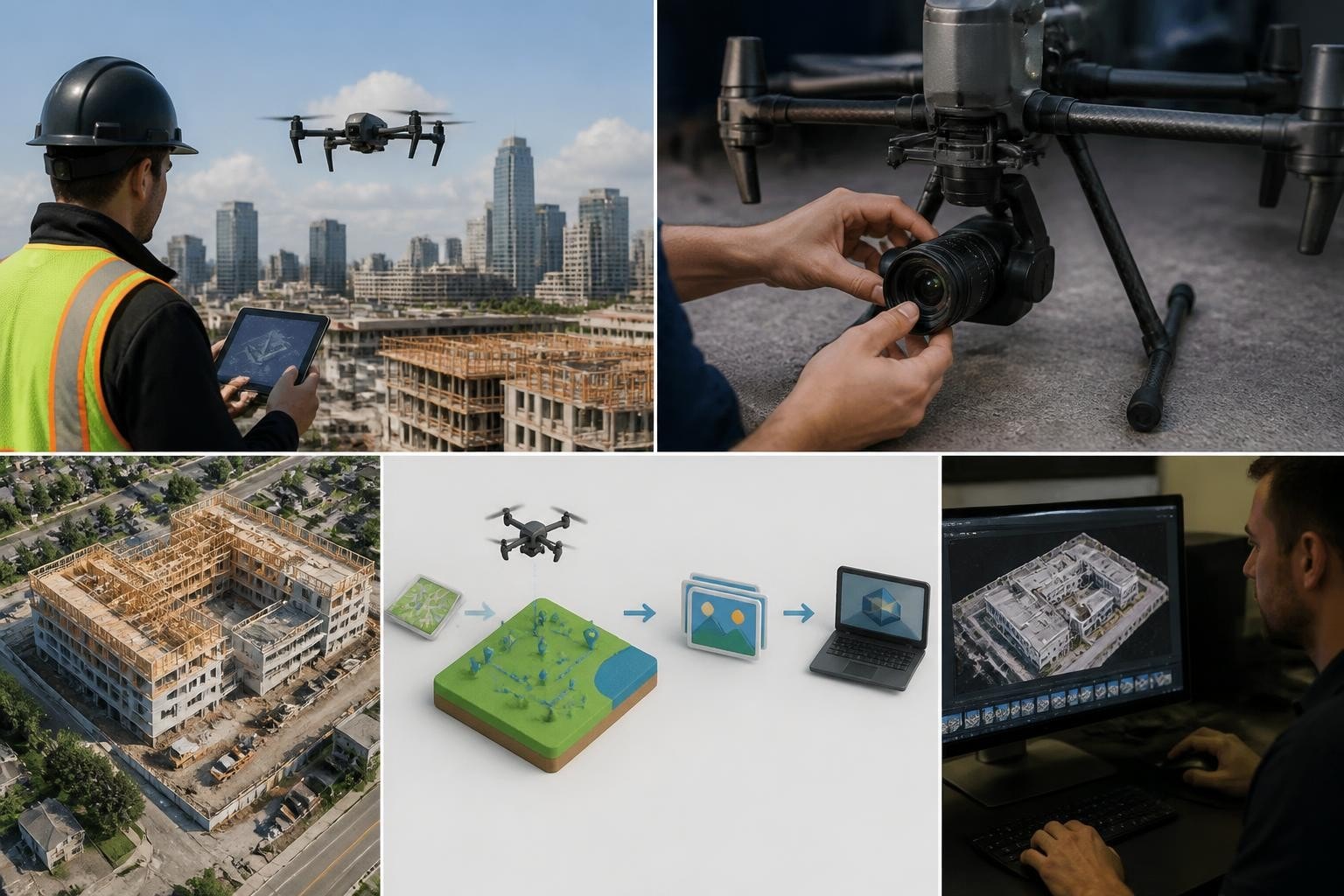
Construction progress documentation requires multi-sensor capabilities within single site visits. A typical Phoenix job site in January 2026 needed orthomosaic base maps, thermal scans of recently poured concrete, and cinematic establishing shots for stakeholder presentations. We flew three missions with different payloads: mapping camera for survey-grade accuracy, thermal sensor for quality control, and cinema rig for marketing materials. Each sensor swap took under ten minutes using quick-release plates and pre-balanced gimbals, completing all deliverables in a four-hour window.
The same modular thinking applies to aerial mapping workflows where survey accuracy depends on precise sensor calibration and consistent flight parameters. We maintain mission profiles for common tasks, standard altitude and overlap settings that produce repeatable results, the way experienced LEGO drone builders develop go-to configurations for specific challenges. That standardization reduces setup time and eliminates variables that compromise data quality.
Safety and Certification Considerations
Educational LEGO drone projects teach students to respect flight regulations before they operate commercial equipment. Understanding airspace restrictions, weather limitations, and pre-flight checklists in low-stakes environments creates better habits than learning those lessons when client deliverables and budgets hang in the balance. We've seen this progression: students who built and crashed hobby quadcopters develop situational awareness that translates directly to professional UAV operations.
Our professional drone operations maintain FAA Part 107 certification, commercial insurance, and detailed pre-flight protocols because mistakes at commercial scale have legal and financial consequences educational projects don't face. That professionalism starts with the same fundamentals students learn when building their first LEGO drone: check battery voltage, verify motor rotation, confirm control surface response before takeoff. The tools change but core safety practices remain constant.
Weather assessment separates educational flights from professional missions. A student team can postpone their test flight if wind speeds exceed safe limits; we coordinate with construction schedules, production crews, and surveyor timelines where delays cascade into budget overruns. We monitor real-time conditions, maintain backup date windows, and communicate proactively when conditions require rescheduling, professionalism that starts with understanding flight limitations learned in educational settings.
Advanced Applications and Future Developments
Recent LEGO Ideas projects showcase exploration drones designed for planetary rover missions, demonstrating how educational platforms inspire innovative thinking about autonomous navigation and sensor integration. While we're not flying Mars rovers, the same autonomous waypoint systems inform our drone surveying and mapping workflows where pre-programmed flight paths ensure consistent overlap and coverage across large Nevada project sites.
Specialized LEGO drone concepts like the Sentinel Drone with LED scanner from gaming culture demonstrate how enthusiast communities drive sensor innovation. Professional equivalents include our thermal and LiDAR integrations for construction and infrastructure projects, where specialized sensors deliver data that standard cameras cannot capture. Both educational and professional builders benefit when sensor technology becomes more accessible and easier to integrate.
The crash-resistant Flybrix design demonstrated in field tests shows how modular construction enables rapid repairs, a principle we apply when maintaining our professional fleet. After a minor collision during a tight-space Las Vegas parking structure inspection in November 2025, we replaced damaged propellers and motor mounts in fifteen minutes using standardized parts from our field kit, completing the mission without returning to base. That rapid-response capability comes from designing systems for maintainability, exactly what LEGO drone builders prioritize.
Building Skills That Transfer to Professional Operations
Student pilots who progress from LEGO drone platforms to commercial operations bring hands-on troubleshooting skills that purely theoretical training doesn't develop. They've diagnosed motor failures, rebalanced off-center payloads, and learned how weather affects lightweight airframes through direct experience. When they join professional crews, they already understand why we check motor temperatures after high-load flights or why we adjust camera exposure before launching rather than correcting in post-production.
Our FPV drone pilots started as hobbyists building racing quadcopters, learning manual flight control and spatial awareness through countless crashes and rebuilds. That foundation translates directly to professional FPV cinematography where we thread tight spaces, track moving subjects, and execute dynamic camera moves that gimbal-stabilized platforms cannot achieve. The skills transfer because core principles remain constant: anticipate momentum, respect physics, practice until moves become instinctive.
Educational programs benefit when students see clear pathways from classroom projects to professional careers. We've hired pilots who started with LEGO robotics competitions, progressed through hobby racing leagues, and eventually pursued commercial certification. That progression demonstrates how foundational skills compound: early lessons in weight distribution and motor thrust calculations become advanced knowledge about payload optimization and mission-specific aircraft configuration.
Equipment Selection and Mission Planning
Professional mission planning requires matching aircraft capabilities to project requirements, the same decision process LEGO drone builders use when selecting components for specific challenges. A heavy-lift platform carries cinema cameras but sacrifices flight time; a lightweight racer offers agility but limited payload capacity. We maintain diverse fleet options because different missions demand different tools, documented across our drones and equipment inventory.
Site-specific constraints drive equipment selection. When documenting vertical construction progress on a Phoenix high-rise in October 2025, we needed a platform that could maintain stable hover in rooftop wind conditions while carrying a high-resolution camera. We chose the Inspire 2 for its weight, motor power, and stabilization systems, rejecting lighter platforms that would struggle in gusty conditions. That matching process mirrors how experienced LEGO drone builders select motors and frame sizes based on intended flight environments.
Multi-day projects require equipment redundancy beyond what educational programs need. During a week-long Las Vegas resort documentation project in September 2025, we deployed two complete airframe setups, duplicate sensor packages, and triple battery inventory. When a primary gimbal developed intermittent faults on day three, we swapped to the backup unit and continued shooting without missing scheduled captures. That level of preparation comes from understanding that professional operations cannot accept equipment-related delays.
Practical Takeaways for Professional UAV Operations
Modular design reduces mission downtime: Standardized mounts and quick-change systems enable sensor swaps in minutes rather than hours, keeping projects on schedule when deliverables require multiple capture types.
Redundancy planning prevents failed missions: Carrying backup airframes, duplicate sensors, and extra batteries transforms potential equipment failures from project-ending disasters into minor inconveniences solved with quick swaps.
Weight calculations determine capability: Understanding how payload additions affect flight time, stability, and motor load allows accurate mission planning and prevents mid-flight performance issues.
Safety protocols scale from education to commercial: Pre-flight checklists, weather assessments, and airspace coordination remain essential whether flying a student project or a high-stakes commercial shoot.
Hands-on experience builds troubleshooting skills: Pilots who've diagnosed and fixed equipment issues in low-pressure educational settings respond faster and more effectively when problems arise during professional missions.
Field Note: Mark emphasizes that the best professional pilots maintain the curiosity they had when building their first LEGO drone or hobby quadcopter. They experiment with new configurations, test equipment limits in controlled settings, and continuously refine techniques rather than assuming they've learned everything. That growth mindset separates competent operators from exceptional ones who consistently deliver results regardless of project complexity.
FAQ: LEGO Drone Concepts and Professional UAV Operations
Can LEGO drone building teach skills relevant to commercial UAV operations? Yes, LEGO drone platforms teach fundamental principles including weight distribution, motor thrust calculation, sensor integration, and flight control theory that directly apply to professional operations. Students who build and troubleshoot educational quadcopters develop hands-on problem-solving skills and understanding of aircraft limitations that translate to commercial missions where equipment reliability and performance optimization determine project success.
How do modular design principles benefit professional drone workflows? Modular systems using standardized mounts and quick-change components enable rapid sensor swaps between missions, reducing downtime when projects require multiple capture types like orthomosaics, thermal scans, and cinematic footage. We regularly complete multi-sensor site documentation in single visits by swapping payloads in under ten minutes, keeping projects on schedule and maximizing billable flight time versus equipment configuration time.
What redundancy systems do professional UAV operations require? Commercial missions demand backup airframes, duplicate sensors, extra batteries, and spare critical components like motors and propellers to prevent equipment failures from causing missed deliverables. We maintain complete secondary setups for primary aircraft, pre-configured and flight-tested, enabling mid-mission swaps when issues arise. That preparation level exceeds educational requirements but proves essential when client schedules and budgets depend on completing captures within specific time windows.
How does educational drone building inform professional equipment selection? Early experience with different frame sizes, motor configurations, and payload capacities teaches how aircraft specifications match mission requirements, knowledge that informs professional equipment purchases and fleet planning. Understanding tradeoffs between flight time, payload capacity, stability, and cost comes from hands-on testing rather than theoretical study, helping professionals choose appropriate tools for specific project types and avoid costly mismatches between equipment capabilities and client deliverables.
What safety lessons transfer from educational to commercial UAV operations? Pre-flight checklists, weather assessment protocols, airspace awareness, and understanding aircraft limitations learned in educational settings become critical practices in commercial operations where regulatory compliance, insurance requirements, and client safety concerns demand rigorous procedures. Professional pilots who developed safety habits early through student projects demonstrate better risk assessment and decision-making than those who first encounter safety protocols only after obtaining commercial certification.
Educational LEGO drone platforms teach the same modular design, weight management, and troubleshooting principles we apply daily across Arizona and Nevada commercial missions. Whether you need multi-sensor construction documentation, cinematic aerials, or survey-grade mapping, we bring professional equipment, proven workflows, and the problem-solving mindset that starts with understanding core flight principles. Extreme Aerial Productions delivers dependable results backed by FAA Part 107 certification, full insurance, and twelve years of commercial experience across Phoenix and Las Vegas markets.
Comments